A nurse wraps a cuff around your arm, pumps it up, watches a dial, and announces two numbers — “120 over 80.” You nod as if you understand. But do you actually know what those numbers mean? What is it that’s being measured? Why does it matter? And why does everyone keep telling you to “watch your blood pressure” as you get older?
If you’ve ever felt confused, intimidated, or simply bored by blood pressure explanations, this guide is for you. No medical jargon, no unnecessary complexity — just a clear, honest explanation of what blood pressure is, why it matters so much, and what you can do about it.
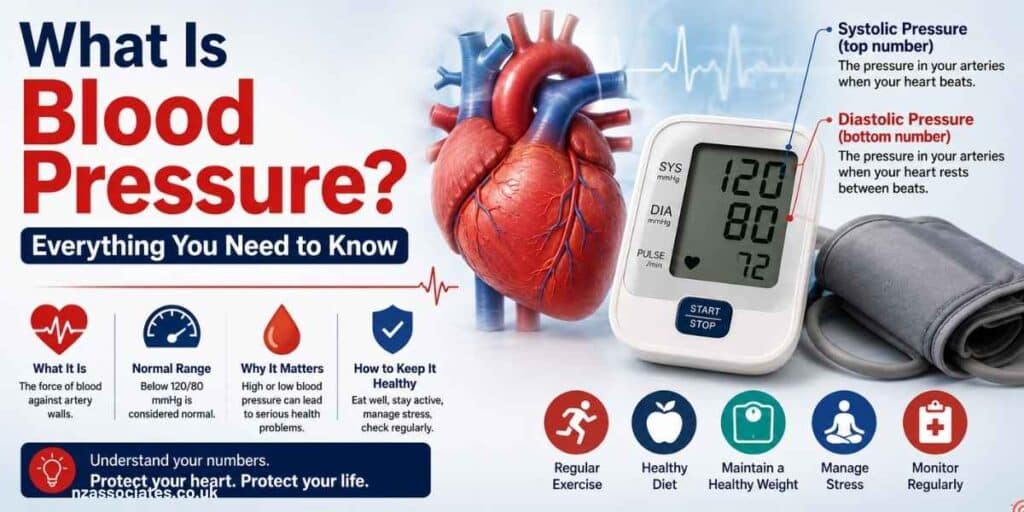
Blood pressure is the force of blood pushing against the walls of your arteries as your heart pumps it around your body. It’s measured as two numbers (e.g. 120/80 mmHg): the top number (systolic) is the pressure when your heart beats, and the bottom number (diastolic) is the pressure when your heart rests between beats. Normal blood pressure is below 120/80 mmHg. High blood pressure (above 140/90 in a clinic) damages arteries silently over time and is the leading modifiable risk factor for heart attack and stroke.
📖 In This Guide
- Blood Pressure Explained Simply
- What Do the Two Numbers Mean?
- What Is Normal Blood Pressure?
- What Is High Blood Pressure? (And Why It’s Called the Silent Killer)
- What Is Low Blood Pressure?
- Why Does Blood Pressure Matter So Much?
- What Makes Blood Pressure Go Up and Down?
- How Is Blood Pressure Measured?
- How Often Should You Get Checked?
- Your Next Steps
- Frequently Asked Questions
1. Blood Pressure Explained Simply (No Medical Jargon)
Imagine your body’s blood vessels as a network of flexible pipes. Your heart is the pump. Every time it beats — around 100,000 times per day — it pushes blood through those pipes, delivering oxygen and nutrients to every organ, muscle, and cell in your body.
Blood pressure is simply the amount of force that blood exerts against the walls of those pipes (your arteries) as it flows through them. Think of it like water pressure in your home’s plumbing — you need enough pressure to push water to every tap, but too much pressure can damage the pipes over time.
That’s genuinely all it is: the force of blood against artery walls. Nothing more complicated than that.
The reason blood pressure matters so much is that — just like plumbing — your pipes can handle a normal range of pressure perfectly well, but consistently high pressure gradually damages them. And unlike your plumbing at home, you can’t call someone to replace a burst blood vessel in your brain.
2. What Do the Two Numbers Mean?
A blood pressure reading is always written as two numbers, one over the other — like 120/80 mmHg (said as “120 over 80”). Here’s what each number tells you:
1 Systolic Pressure (The Top Number)
This is the peak pressure inside your arteries at the exact moment your heart squeezes and pushes blood out. It’s always the higher of the two numbers. Think of it as the “surge” — the maximum force wave that travels through your blood vessels with every heartbeat.
2 Diastolic Pressure (The Bottom Number)
This is the lowest pressure in your arteries during the brief pause between heartbeats, when your heart is resting and refilling with blood. It represents the baseline pressure your arteries maintain even when the heart isn’t actively pumping.
? What Does “mmHg” Mean?
It stands for millimetres of mercury — the traditional unit used to measure pressure. Old-fashioned blood pressure monitors actually contained a column of mercury that rose and fell with the pressure. The unit stuck even though modern monitors are digital.
Systolic = Squeeze (heart squeezing blood out)
Diastolic = Down-time (heart resting between beats)
Deep Dive: Systolic vs Diastolic — Which Number Matters More?
Why the answer changes with your age, and what to do when only one number is high.
3. What Is Normal Blood Pressure?
In the UK, the NHS defines blood pressure categories as follows:
If either number is elevated — not both — your blood pressure is still considered high. A reading of 150/78 means you have high blood pressure, even though the bottom number looks fine. Many people wrongly assume both numbers need to be high before there’s a problem.
📈 What Do Your Numbers Mean?
Enter your reading into our free calculator and get an instant, plain-English explanation of where you stand.
4. What Is High Blood Pressure? (And Why It’s Called the Silent Killer)
High blood pressure — known medically as hypertension — means the force of blood against your artery walls is consistently too high. The NHS defines it as a clinic reading of 140/90 mmHg or above (or 135/85 at home).
The reason it’s called the “silent killer” is that it almost never produces symptoms. You can walk around with dangerously high blood pressure for years without feeling anything unusual. Meanwhile, that excess pressure is quietly damaging your arteries, heart, brain, kidneys, and eyes — increasing your risk of:
- Heart attack — damaged arteries restrict blood flow to the heart
- Stroke — weakened blood vessels in the brain burst or become blocked
- Heart failure — the heart thickens and weakens from years of overwork
- Kidney disease — damaged blood vessels reduce kidney function
- Vision loss — damaged blood vessels in the retina
- Vascular dementia — reduced blood flow to brain tissue
According to the British Heart Foundation, around 1 in 3 adults in the UK has high blood pressure — but nearly half of them don’t know it, because they’ve never been checked.
5. What Is Low Blood Pressure?
Low blood pressure — known as hypotension — is generally defined as a reading below 90/60 mmHg. Unlike high blood pressure, low blood pressure is only considered a problem if it causes symptoms like dizziness, fainting, blurred vision, or fatigue.
Many people — particularly young, active adults and athletes — have naturally low blood pressure and feel perfectly fine. In fact, for them, it’s often a sign of excellent cardiovascular fitness.
Deep Dive: Low Blood Pressure — Causes, Symptoms & When to Worry
Complete guide to hypotension including types, red flags, and when to see your GP.
6. Why Does Blood Pressure Matter So Much?
Blood pressure is one of the five vital signs that healthcare professionals use to assess your health — alongside heart rate, breathing rate, temperature, and oxygen levels. It matters because:
- It’s the single biggest modifiable risk factor for cardiovascular disease — the leading cause of death in the UK
- It’s completely controllable — through lifestyle changes, medication, or both
- It’s free and easy to measure — you can check it at home, at a pharmacy, or at your GP surgery
- It’s silent — without measuring it, you cannot know whether it’s too high
Put simply: you cannot feel your blood pressure. The only way to know if it’s too high or too low is to measure it. And once you know your numbers, you can take action to protect yourself.
7. What Makes Blood Pressure Go Up and Down?
Blood pressure is not a fixed number — it changes constantly throughout the day. Understanding what affects it helps you make sense of your readings:
Because blood pressure fluctuates so much, a single reading is never enough to tell the full story. That’s why doctors recommend averaging multiple readings over several days before drawing conclusions.
Related: How to Work Out Your Average Blood Pressure
Why averaging multiple readings is the most accurate way to know your true blood pressure.
8. How Is Blood Pressure Measured?
Blood pressure is measured using a device called a sphygmomanometer (pronounced “sfig-mo-ma-NOM-eter”) — although most people just call it a “blood pressure monitor” or “BP cuff.” There are two main ways it’s done:
At Your GP Surgery or Pharmacy: A nurse or pharmacist places an inflatable cuff around your upper arm, inflates it to briefly stop blood flow, then slowly releases it while listening with a stethoscope (manual) or using a digital sensor (automatic). The whole process takes about 60 seconds.
At Home: You can buy a validated automatic blood pressure monitor for £20–60. You place the cuff on your bare upper arm, press a button, and the machine does everything — inflating, measuring, and displaying your systolic, diastolic, and pulse rate on a screen.
The NHS recommends using a BIHS-validated upper-arm monitor (not a wrist device). You can check the British and Irish Hypertension Society’s approved list at bihsoc.org. Wrist monitors are less reliable because the wrist must be held at exactly heart level for an accurate reading — a position most people get wrong.
Step-by-Step: How to Measure Blood Pressure at Home
The exact 6-step clinical technique — plus 8 common mistakes that ruin your reading.
9. How Often Should You Get Your Blood Pressure Checked?
You can get your blood pressure checked free of charge at your GP surgery, many high-street pharmacies (Boots, Lloyds, Superdrug), and some community health events.
10. Your Next Steps: Where to Go From Here
Now you understand what blood pressure is. Here’s what to do next:
✔ Step 1: Get your blood pressure checked — at your GP, pharmacy, or at home with a validated monitor
✔ Step 2: Check what your numbers mean using our free BP calculator
✔ Step 3: If your reading is elevated, take multiple readings over a week and calculate your average
✔ Step 4: If your average is above 135/85 (home) or 140/90 (clinic), book a GP appointment
🏥 Check Your Numbers Now
Enter your reading into our free calculator and get an instant, plain-English explanation.
11. Frequently Asked Questions
What does blood pressure mean?
Blood pressure is the force of blood pushing against the walls of your arteries as your heart pumps it around your body. It’s measured as two numbers: systolic (pressure during a heartbeat) over diastolic (pressure between beats), in millimetres of mercury (mmHg).
What is a good blood pressure reading?
A good blood pressure reading for most adults is between 90/60 and 120/80 mmHg. This is considered the ideal, healthy range by the NHS. Readings above 140/90 in a clinic (or 135/85 at home) are classified as high blood pressure.
What do the two numbers in a blood pressure reading mean?
The top number (systolic) measures the pressure when your heart beats and pushes blood out. The bottom number (diastolic) measures the pressure between beats when your heart is resting. Both numbers matter — if either is too high, your blood pressure is considered elevated.
Can you feel high blood pressure?
No — this is exactly why high blood pressure is called the “silent killer.” It almost never produces symptoms until it has already caused significant damage to your arteries, heart, or brain. The only way to know if your blood pressure is high is to measure it.
Does blood pressure change with age?
Yes. Blood pressure tends to increase gradually with age as arteries become stiffer. However, the NHS diagnostic threshold for high blood pressure (140/90 mmHg) remains the same regardless of age. A reading that’s “normal for your age” may still be clinically elevated.
What does mmHg stand for?
mmHg stands for “millimetres of mercury.” It’s the standard unit for measuring blood pressure worldwide. The name comes from early blood pressure monitors that contained a column of liquid mercury — the height of the mercury (in millimetres) indicated the pressure.
How can I lower my blood pressure?
The most effective natural methods include reducing salt intake, following the DASH diet, exercising regularly (150 minutes per week), losing excess weight, limiting alcohol to under 14 units per week, and managing stress. Combined, these changes can lower blood pressure by 20–30 mmHg or more.
Where can I get my blood pressure checked for free?
In the UK, you can get your blood pressure checked free at your GP surgery, many high-street pharmacies (Boots, Lloyds, Superdrug), and through the NHS Health Check programme for adults aged 40–74. Some workplaces and community health events also offer free checks.