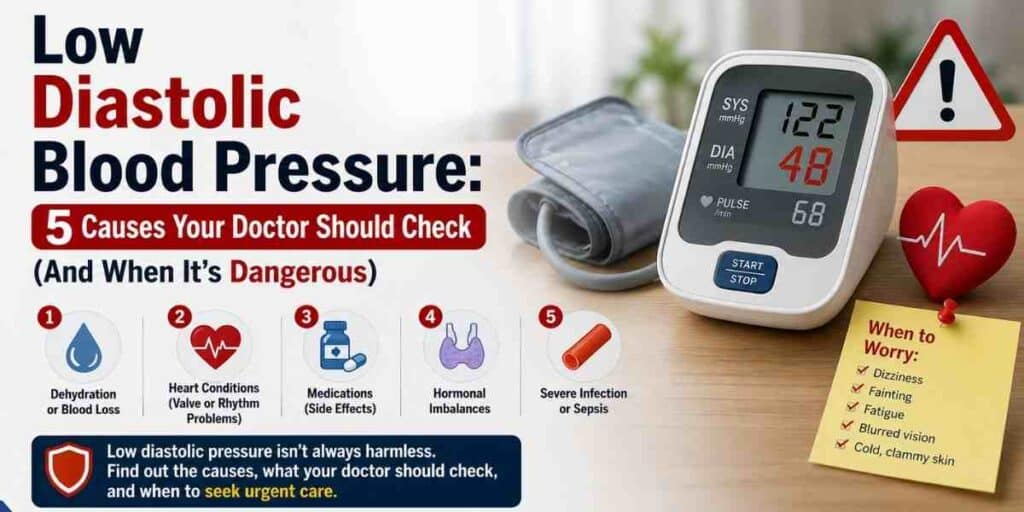
You check your blood pressure and the top number looks perfectly normal — 128, maybe 132. But the bottom number? It’s sitting at 55. Or 52. Or even lower. Something about it feels wrong, but you’re not sure why. After all, isn’t low blood pressure supposed to be a good thing?
Not always. While most attention goes to the systolic (top) number, a diastolic reading that drops below 60 mmHg — especially in older adults or people with existing heart conditions — can be a genuine warning sign. In some cases, it’s actually more dangerous than a high reading. And yet, it’s one of the most commonly overlooked patterns in routine blood pressure checks.
This guide explains what low diastolic blood pressure actually means, why it happens, the “J-curve” danger that most people have never heard of, and the specific situations where you need to act.
A diastolic reading below 60 mmHg is generally considered low. It becomes clinically significant when it drops below 50 mmHg, particularly in older adults or people with coronary artery disease. Low diastolic pressure can reduce blood flow to the heart muscle itself — creating a paradox where your blood pressure is “low” but your risk is actually higher. Common causes include age-related arterial stiffness, over-treatment with blood pressure medication, aortic valve disease, and dehydration. If your diastolic is consistently below 60, it’s worth discussing with your GP.
📖 In This Guide
- What Is Low Diastolic Blood Pressure?
- Why Low Diastolic Matters More Than You Think
- The J-Curve: The Hidden Danger Nobody Talks About
- 5 Causes Your Doctor Should Be Checking
- Symptoms You Shouldn’t Ignore
- When the Gap Between Your Numbers Gets Too Wide
- Can Blood Pressure Medication Push Diastolic Too Low?
- What to Do If Your Diastolic Is Low
- Frequently Asked Questions
1. What Is Low Diastolic Blood Pressure?
Diastolic blood pressure is the bottom number in your reading. It measures the pressure inside your arteries during the brief pause between heartbeats — when your heart is relaxing and refilling with blood. Think of it as the “resting” pressure your arteries maintain even when your heart isn’t actively pumping.
A healthy diastolic reading typically falls between 60 and 80 mmHg. When it consistently drops below 60 mmHg, it’s classified as low diastolic blood pressure — a condition known medically as diastolic hypotension.
Low diastolic blood pressure is not the same as general low blood pressure (hypotension). With general hypotension, both numbers are low (e.g. 85/55). With isolated low diastolic, the top number can be perfectly normal or even high while the bottom number drops — for example, 142/52. This pattern tells a very different clinical story and carries its own unique risks.
2. Why Low Diastolic Matters More Than You Think
Here’s the fact that surprises most people: your heart muscle receives its own blood supply during the diastolic phase — the resting period between beats. Unlike every other organ in your body, the coronary arteries (the blood vessels that feed the heart itself) fill primarily when the heart is relaxing, not when it’s contracting.
This means that diastolic pressure directly determines how much blood your heart muscle receives. When diastolic pressure drops too low, the perfusion pressure driving blood into the coronary arteries falls too — potentially starving the heart muscle of oxygen, even though the rest of your body is getting adequate blood flow.
This is particularly dangerous for anyone who already has coronary artery disease — narrowed arteries that are already struggling to deliver enough blood to the heart. For these patients, a diastolic reading below 60 mmHg can genuinely increase the risk of heart attack.
Many people assume that lower blood pressure is always better. For systolic pressure, that’s largely true down to a point. But for diastolic pressure, pushing it too low can actually increase cardiac risk — particularly in older adults with stiff arteries and existing heart disease. This is the basis of the “J-curve” phenomenon that cardiologists have debated for decades.
3. The J-Curve: The Hidden Danger Nobody Talks About
The “J-curve” is one of the most important — and least publicly discussed — concepts in blood pressure management. It describes a pattern observed across multiple large clinical studies: as diastolic blood pressure falls below a certain threshold (approximately 60–70 mmHg), cardiovascular risk doesn’t continue to decrease as you’d expect. Instead, it curves back upward — forming the shape of the letter “J.”
In practical terms, this means:
- A diastolic of 80 mmHg → lower risk (good)
- A diastolic of 70 mmHg → even lower risk (better)
- A diastolic of 60 mmHg → risk starts to flatten (caution zone)
- A diastolic of 50 mmHg → risk begins climbing again (danger zone for vulnerable patients)
Research published in the Journal of the American College of Cardiology and the European Heart Journal has consistently shown this pattern, particularly in patients with pre-existing coronary artery disease. A 2019 analysis of over 8,500 patients in the CLARIFY registry found that patients with a diastolic below 60 mmHg had a significantly higher rate of major cardiac events compared to those with diastolic readings between 70–79 mmHg.
If you’re on blood pressure medication and your systolic is well-controlled but your diastolic has dropped below 60, it’s worth asking your GP whether your medication dose needs adjusting. The goal isn’t just to lower the top number — it’s to keep both numbers in a safe range.
4. 5 Causes of Low Diastolic Blood Pressure Your Doctor Should Be Checking
🔴 Cause #1: Age-Related Arterial Stiffness (The Most Common)
This is by far the most frequent reason for low diastolic pressure, particularly in adults over 55. As arteries stiffen with age, they lose the ability to gently “recoil” between heartbeats. In a young person, flexible arteries stretch with each beat and then spring back, maintaining diastolic pressure. In stiffened arteries, this recoil is weak or absent — so diastolic pressure falls while systolic pressure often rises simultaneously.
The result: readings like 148/58 or 156/52 — high systolic with low diastolic, creating a dangerously wide gap. This pattern is called isolated systolic hypertension with low diastolic, and it’s one of the most challenging patterns for GPs to treat, because medication that lowers the systolic number may push the diastolic even lower.
🔴 Cause #2: Over-Treatment With Blood Pressure Medication
This is more common than many people realise. Blood pressure medications lower both systolic and diastolic readings — they can’t selectively target just one number. If medication is dosed to bring a high systolic reading down to target, the diastolic can get pulled down too far in the process.
This is especially relevant for older adults who started medication when both numbers were high, but whose diastolic has naturally fallen with age. The medication that was appropriate 10 years ago may now be pushing their diastolic into an unsafe range.
If you suspect your medication is pushing your diastolic too low, do not stop or reduce your medication on your own. Speak to your GP — they can adjust the dose, change the timing, or switch to a different class of medication that may have a more balanced effect on both numbers.
🔴 Cause #3: Aortic Valve Regurgitation
In this condition, the aortic valve (the main valve controlling blood flow from the heart into the body) doesn’t close properly. With each heartbeat, some blood leaks backward into the heart instead of flowing forward. This reduces the residual pressure in the arteries during the resting phase — directly lowering diastolic pressure.
Aortic regurgitation often produces a characteristically wide pulse pressure — for example, a reading of 150/45 mmHg. It may be accompanied by a heart murmur that your GP can detect with a stethoscope. Diagnosis is confirmed with an echocardiogram (heart ultrasound).
🔴 Cause #4: Dehydration and Blood Volume Loss
When your body doesn’t have enough fluid, total blood volume drops — and diastolic pressure is often the first to fall. This can happen during hot weather, after prolonged exercise, during illness (vomiting, diarrhoea), or simply from not drinking enough water throughout the day.
In older adults, the thirst mechanism becomes less sensitive, making chronic mild dehydration surprisingly common — and a frequently overlooked contributor to low diastolic readings.
🔴 Cause #5: Endocrine and Hormonal Conditions
Several hormonal conditions can lower diastolic pressure:
- Addison’s disease (adrenal insufficiency) — reduces aldosterone production, which controls sodium and fluid balance
- Hyperthyroidism — increases heart rate and cardiac output, widening the gap between systolic and diastolic
- Severe anaemia — the heart pumps harder to compensate for fewer red blood cells, raising systolic while diastolic may fall
5. Symptoms You Shouldn’t Ignore
Many people with mildly low diastolic readings (55–59 mmHg) have no symptoms at all. However, as the number drops further, or if you have underlying heart disease, symptoms may appear:
- Dizziness or lightheadedness, especially when standing
- Fatigue and general weakness that doesn’t improve with rest
- Difficulty concentrating or “brain fog”
- Blurred vision
- Nausea
- Cold, clammy skin
- Chest pain or tightness (especially concerning — could indicate reduced coronary blood flow)
🚨 Seek Urgent Help If:
- You experience chest pain or pressure alongside a low diastolic reading
- You faint or lose consciousness
- Your diastolic reading drops below 40 mmHg
- You feel confused, drowsy, or unable to stay alert
These could indicate that your heart or brain is not receiving enough blood. Call 999 or go to A&E immediately.
6. When the Gap Between Your Numbers Gets Too Wide
When systolic is high and diastolic is low, the gap between them — called pulse pressure — becomes unusually wide. A normal pulse pressure is around 40–60 mmHg. When it consistently exceeds 60 mmHg, it’s an independent cardiovascular risk factor, even if neither individual number looks dramatically alarming on its own.
Example: A reading of 148/56 gives a pulse pressure of 92 mmHg — well above the healthy range. This wide gap signals that the arteries are stiff and struggling to buffer the force of each heartbeat.
Related: Pulse Pressure Explained — What the Gap Between Your Numbers Really Means
Full guide including wide vs narrow pulse pressure, cardiovascular risk, and when to act.
7. Can Blood Pressure Medication Push Diastolic Too Low?
Yes — and this is more common than most patients realise. All standard blood pressure medications lower both numbers simultaneously. They cannot selectively reduce systolic while preserving diastolic.
This creates a specific problem for older adults with isolated systolic hypertension (e.g. 160/62). To get the systolic down to the target of 140 or below, medication may inadvertently push the diastolic from 62 down to 48 — which could be more dangerous than leaving the systolic slightly elevated.
Medications most likely to drop diastolic pressure include:
- Alpha-blockers (e.g. Doxazosin) — often used for prostate conditions
- Diuretics at high doses — reduce blood volume, lowering both numbers
- Nitrates — used for angina, cause significant vasodilation
- Combination therapy — taking multiple BP medications can have a cumulative effect on diastolic
If your diastolic is consistently below 60 and you’re on blood pressure medication, ask your GP whether a dose adjustment or medication change might provide a better balance between managing your systolic number and protecting your diastolic floor.
Related: Blood Pressure Medications — Types, Side Effects & What to Expect
Complete guide to the 5 main types of BP medication prescribed in the UK.
8. What to Do If Your Diastolic Is Consistently Low
If Your Diastolic Is 50–59 mmHg (No Symptoms)
- Monitor regularly — take readings at the same times each day for a week
- Stay well hydrated (2–3 litres of fluid per day)
- Mention it at your next GP appointment — especially if you’re on medication
- Note any symptoms, however mild (dizziness, fatigue)
If Your Diastolic Is Below 50 mmHg (Or You Have Symptoms)
- Book a GP appointment promptly — don’t wait for your annual review
- Bring a log of your recent readings
- Your GP may order blood tests (thyroid function, kidney function, anaemia screen), an ECG, or an echocardiogram
- If you’re on BP medication, your GP may review and adjust your prescription
If Your Diastolic Drops Below 40 mmHg (Or You Have Chest Pain/Confusion)
- This is urgent — call 999 or go to A&E
- Sit or lie down to prevent falling
- Do not take any additional medication unless advised by a healthcare professional
📈 Track Both Your Numbers
Enter multiple readings into our free calculator to see your average systolic and diastolic — plus whether your pulse pressure (the gap) is in the healthy range.
9. Frequently Asked Questions
What is considered low diastolic blood pressure?
A diastolic reading below 60 mmHg is generally considered low. It becomes more clinically significant below 50 mmHg, particularly in older adults or people with existing heart disease, as it may reduce blood flow to the heart muscle itself.
Is low diastolic blood pressure dangerous?
It can be. Research shows that diastolic pressure below 60 mmHg, especially in people with coronary artery disease, is associated with increased cardiovascular risk — a phenomenon known as the “J-curve.” This is because the heart muscle relies on diastolic pressure to receive its own blood supply through the coronary arteries.
What causes low diastolic blood pressure?
The most common cause in older adults is age-related arterial stiffness, which reduces the arteries’ ability to maintain pressure between heartbeats. Other causes include over-treatment with blood pressure medication, aortic valve regurgitation, dehydration, and hormonal conditions like hyperthyroidism or Addison’s disease.
Can blood pressure medication cause low diastolic?
Yes. All standard blood pressure medications lower both systolic and diastolic readings simultaneously. In older adults whose diastolic has naturally fallen with age, medication doses that were appropriate years ago may now push diastolic into an unsafe range. If your diastolic is consistently below 60 while on medication, ask your GP about a dose review.
What does it mean when systolic is high but diastolic is low?
This pattern — for example, 155/52 — indicates a wide pulse pressure, most commonly caused by arterial stiffness. It is particularly common in older adults. The wide gap is an independent cardiovascular risk factor and should be monitored by your GP, even if neither number alone looks alarming.
What is the J-curve in blood pressure?
The J-curve describes a pattern where cardiovascular risk decreases as diastolic blood pressure falls from high levels, but then starts to increase again once it drops below approximately 60–70 mmHg. The graph of risk versus diastolic pressure forms a “J” shape — too high is bad, but too low is also bad, particularly for the heart.
Should I worry if my diastolic is 55?
A single reading of 55 is not necessarily cause for alarm, especially if you feel well and have no symptoms. However, if your diastolic is consistently around 55 or below, it’s worth mentioning to your GP — particularly if you’re over 60, have heart disease, or are taking blood pressure medication.