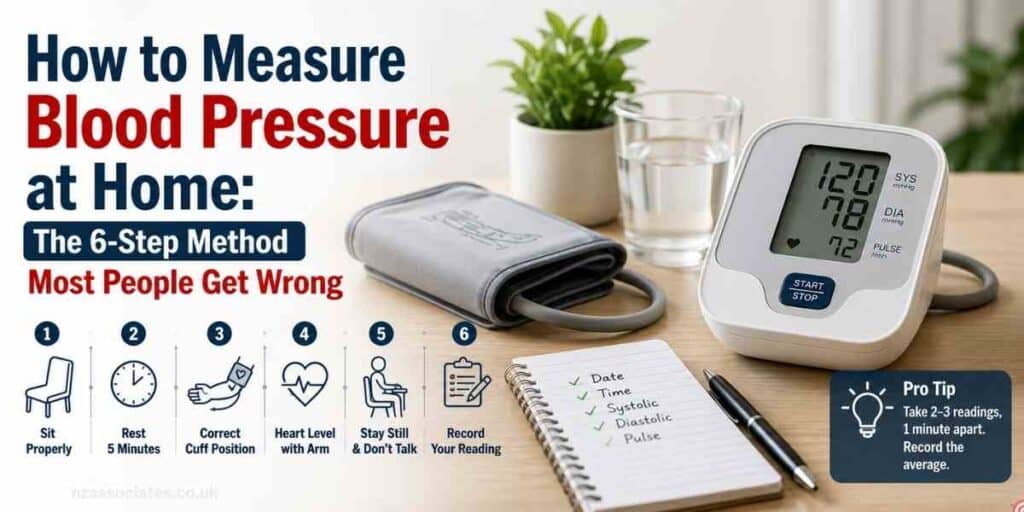
Sit quietly for 5 minutes. Place the cuff on your bare upper arm at heart level. Take two readings, 1–2 minutes apart, twice daily (morning and evening) for at least 4–7 days. Discard the first day’s readings. Average the rest. Use a BIHS-validated upper-arm monitor — never a wrist device unless medically advised. An average home reading of 135/85 mmHg or above is considered high (compared to 140/90 in a clinic). This is the NICE-recommended protocol for confirming hypertension.
You’ve bought a blood pressure monitor. You’ve strapped on the cuff. You press the button and get a number. But here’s what nobody tells you: how you take that reading matters just as much as the number itself. Get the technique wrong, and your reading could be off by 10, 15, even 20 points — enough to turn a perfectly normal reading into a false alarm, or worse, mask genuinely high blood pressure.
The NHS, NICE guidelines, and the British and Irish Hypertension Society (BIHS) all agree: home blood pressure monitoring is one of the most powerful tools available for managing your cardiovascular health. But only if you do it correctly. This guide gives you the exact clinical protocol that GPs and practice nurses follow — adapted for your kitchen table.
📖 In This Guide
- Why Home Monitoring Is More Accurate Than Your GP’s Reading
- What You Need Before You Start
- The 6-Step Method (NICE Clinical Protocol)
- 8 Common Mistakes That Ruin Your Reading
- When and How Often Should You Measure?
- Interpreting Your Home Readings (Home vs Clinic Thresholds)
- How to Average Your Readings (The NICE Way)
- Which Arm Should You Use?
- Special Situations: Pregnancy, Elderly, Anxiety
- When to Worry About a Home Reading
- Frequently Asked Questions
1. Why Home Monitoring Is More Accurate Than Your GP’s Reading
This might surprise you: the blood pressure reading your GP takes in the surgery is often less accurate than one you take at home. This isn’t because your GP’s equipment is poor — it’s because the environment itself skews the result.
Up to 30% of people experience “white coat hypertension” — a temporary spike triggered by the stress of being in a clinical setting. Conversely, some people show normal readings at the GP but have genuinely elevated pressure in everyday life (“masked hypertension”). Both patterns are invisible to a single clinic reading.
This is exactly why NICE guideline NG136 now states that home blood pressure monitoring (HBPM) or ambulatory blood pressure monitoring (ABPM) should be used to confirm a diagnosis of hypertension — not a single clinic reading alone. Your home readings, taken correctly over several days, give a more reliable picture of your true blood pressure than any snapshot in a surgery.
The NHS Blood Pressure @home programme has already distributed over 220,000 monitors across England, enabling patients to take accurate readings in their own homes. Home monitoring is no longer a nice-to-have — it’s a core part of modern hypertension management.
2. What You Need Before You Start
The Right Monitor
Use an automatic, upper-arm blood pressure monitor that has been validated for clinical accuracy by the British and Irish Hypertension Society (BIHS). This is non-negotiable — an unvalidated monitor could be off by 10+ mmHg, rendering your readings meaningless.
Wrist monitors are significantly less reliable than upper-arm devices. The wrist must be held at exactly heart level for an accurate reading — a position most people get wrong. The NHS, BHF, and BIHS all recommend upper-arm monitors as the standard for home use. Only use a wrist monitor if your GP specifically advises it (e.g., for very large arm circumference).
The Right Cuff Size
A cuff that’s too small will overestimate your blood pressure. A cuff that’s too large will underestimate it. Measure around the midpoint of your bare upper arm:
Related: Best Home Blood Pressure Monitor (BIHS-Approved Buying Guide)
Our shortlist of BIHS-validated monitors with model comparisons and cuff sizing advice.
3. The 6-Step Method: How to Measure Blood Pressure at Home (NICE Protocol)
Follow this exact sequence every time. Each step is backed by the NICE clinical protocol and endorsed by the British Heart Foundation.
1 Prepare (30 Minutes Before)
- Avoid caffeine (coffee, tea, energy drinks) for at least 30 minutes
- Don’t exercise for at least 30 minutes
- Don’t smoke for at least 30 minutes
- Empty your bladder — a full bladder can add 10–15 mmHg to your reading
2 Sit Correctly (5 Minutes of Quiet Rest)
- Sit in a supportive chair with your back fully supported
- Keep both feet flat on the floor — do not cross your legs (this can add 2–8 mmHg)
- Rest quietly for 5 full minutes before taking any reading
- Don’t check your phone, watch TV, or have a conversation during this time
3 Position the Cuff Correctly
- Place the cuff on your bare upper arm — never over clothing
- Position the bottom edge of the cuff 2–3 cm above the elbow crease
- The artery marker on the cuff (usually a line or arrow) should align with the brachial artery (inner arm)
- Support your arm on a table so the cuff is at heart level — use a cushion if needed
- Keep your arm relaxed, palm facing upward
4 Take the First Reading
- Press the start button and sit completely still
- Do not talk during the reading — talking alone can raise systolic by 10–15 mmHg
- Don’t move, tense your muscles, or look at the screen until it’s finished
- Record both the systolic and diastolic numbers, plus your pulse
5 Wait 1–2 Minutes, Then Take a Second Reading
- Leave the cuff in place but relaxed
- Wait at least 1 minute (ideally 2 minutes) before taking the second reading
- Record the second reading separately
- Your GP will typically use the second (lower) reading as the more accurate one
6 Log Your Readings
- Record the date, time, systolic, diastolic, and pulse rate
- Note anything relevant (e.g. “felt stressed,” “after exercise,” “missed medication”)
- Use a diary, app, or our free calculator to track your average over time
📈 Calculate Your True Average
Enter your home readings into our free calculator to average them and see your real blood pressure — not just one snapshot.
4. 8 Common Mistakes That Can Ruin Your Reading (And By How Much)
Each of these errors has been measured in clinical studies. The numbers might shock you:
The cumulative effect is staggering. If you talk while measuring, cross your legs, have a full bladder, and skip the rest period — your systolic reading could be inflated by 30–50+ mmHg. That’s enough to turn a perfectly normal 118 into a panic-inducing 160.
5. When and How Often Should You Measure?
For Confirming a New Diagnosis (NICE Protocol)
If your GP has asked you to monitor at home to confirm whether you have hypertension:
- Take two readings, 1–2 minutes apart, in the morning (before food and medication)
- Take two readings, 1–2 minutes apart, in the evening
- Do this for at least 4 days, ideally 7 days
- Discard the entire first day’s readings (anxiety about the process tends to inflate them)
- Average everything from day 2 onward
For Ongoing Monitoring (Already Diagnosed)
Once diagnosed and on treatment, measure at least twice a week — or as your GP advises. Take readings at the same times each day for consistency. Bring your log to every GP review.
For General Health Monitoring (No Known Issues)
If your blood pressure is normal and you have no risk factors, checking once every 6–12 months at home (or at your pharmacy/GP) is reasonable. If you have a family history of hypertension, checking monthly is sensible.
Morning: Before breakfast, before taking any medication, after using the toilet. This is your most “natural” baseline reading.
Evening: Before dinner or at least 30 minutes after eating. Avoid measuring right after work or a stressful commute — sit quietly first.
6. Interpreting Your Home Readings: The Thresholds Are Different
This is one of the most important — and most commonly misunderstood — facts about home monitoring: the threshold for high blood pressure is lower at home than in a clinic.
Source: NICE guideline NG136.
This means a home reading of 136/86 is already above the home threshold — even though it would look “borderline normal” by clinic standards. If your home average over 4–7 days is at or above 135/85, your GP will typically classify this as hypertension.
7. How to Average Your Readings the NICE Way
The NICE protocol is specific about how to calculate your average:
- Discard all Day 1 readings entirely — first-day anxiety inflates them
- From Day 2 onward, use the second reading from each session (it’s typically more accurate than the first)
- Add up all remaining systolic readings and divide by the total count. Do the same for diastolic.
- Your result = your true home average
Example: 7 days × 2 sessions × 1 reading each = 14 readings. Discard Day 1 (2 readings removed) = 12 readings to average.
Related: How to Work Out Your Average Blood Pressure
Full walkthrough of the averaging process with worked examples.
8. Which Arm Should You Use?
When you first start monitoring, take readings from both arms. If there’s a consistent difference of more than 15 mmHg between them, always use the arm with the higher reading going forward — and tell your GP about the difference, as it can indicate narrowed arteries on one side.
If the difference between arms is less than 15 mmHg, simply pick one arm and stick with it every time. Consistency matters more than which arm you choose.
Related: Why Your Blood Pressure Can Be Different in Each Arm
What a between-arm difference really means and when to worry.
9. Special Situations: Pregnancy, Elderly, and Anxiety
During Pregnancy
Home monitoring is particularly valuable during pregnancy, where blood pressure changes can signal pre-eclampsia. Use the same arm and same technique as above, and report any reading of 140/90 or above — or any sudden increase — to your midwife immediately. Make sure your monitor is validated for use in pregnancy (not all are).
For Older Adults
Older adults are more likely to have orthostatic hypotension — a drop in blood pressure upon standing. If you experience dizziness when standing up, your GP may ask you to take readings both sitting and standing (immediately after standing, and again after 1 minute). Use a chair with armrests for safety.
If You Have “Monitor Anxiety”
Some people experience anxiety specifically about checking their blood pressure — a kind of “white coat effect” at home. If this sounds like you, try slow deep breathing for 2–3 minutes before the rest period, and look away from the screen while the measurement runs. Focusing on the numbers in real-time can spike your reading further. Over time, most people find the anxiety fades as monitoring becomes routine.
10. When to Worry About a Home Reading
🚨 Take Action Based on These Home Readings:
- Home average above 135/85 mmHg — Book a GP appointment. This is above the home threshold for hypertension.
- Any single reading above 180/110 mmHg — Sit quietly for 5 minutes and re-check. If it remains this high and you have symptoms (severe headache, chest pain, vision changes, confusion), call 999 immediately.
- Any single reading above 180/110 without symptoms — Contact NHS 111 or your GP for urgent same-day advice.
- Readings consistently below 90/60 with symptoms (dizziness, fainting, fatigue) — See your GP.
- A difference of more than 15 mmHg between arms — Tell your GP at your next appointment.
One high reading on its own is not a diagnosis. Blood pressure fluctuates throughout the day — stress, caffeine, a poor night’s sleep, or even a full bladder can temporarily spike your numbers. What matters is the trend over days and weeks, not any single measurement.
🏥 See the Bigger Picture
One reading tells you very little. Enter multiple readings into our free calculator to see your true average and category.
11. Frequently Asked Questions
How often should I check my blood pressure at home?
For a new diagnosis, twice daily (morning and evening) for 4–7 days per the NICE protocol. For ongoing monitoring, at least twice a week or as your GP advises. For general health checks with no known issues, every 6–12 months is reasonable.
Should I take blood pressure before or after eating?
Before eating is ideal, especially for morning readings. Eating — particularly a large meal — can cause blood pressure to drop temporarily (postprandial hypotension) or can interfere with accurate measurement. Wait at least 30 minutes after a meal before measuring.
Should I take blood pressure before or after medication?
The NICE protocol recommends taking morning readings before medication. This captures your “trough” reading — the point when your medication from the previous day has worn off most — which gives your GP the most useful data for assessing whether your medication dose is adequate.
Why is my first reading always higher than the second?
This is extremely common and perfectly normal. The first reading often reflects residual anxiety or muscle tension from positioning the cuff. By the second reading, you’ve relaxed further. This is exactly why the NICE protocol recommends recording the second reading as the primary measurement.
Is 140/90 high at home?
Yes. The home threshold for hypertension is 135/85 mmHg — lower than the clinic threshold of 140/90. A home reading of 140/90 is already above the home cutoff and would be classified as Stage 1 Hypertension on home monitoring. Speak to your GP.
Can I use a wrist blood pressure monitor at home?
Wrist monitors are less reliable than upper-arm devices because the wrist must be positioned at exactly heart level for an accurate reading — a technique most people get wrong. The NHS, BHF, and BIHS all recommend upper-arm monitors as the standard for home use. Only use a wrist device if your GP specifically advises it.
My blood pressure is different every time I check — is that normal?
Yes. Blood pressure is inherently variable — it fluctuates minute to minute based on your activity, stress levels, hydration, posture, and even the time of day. This is precisely why averaging multiple readings over several days is more meaningful than reacting to any single measurement.
What is the best time of day to take blood pressure?
Morning (before food, caffeine, and medication) and evening (before dinner) are the recommended times. Consistency is more important than the exact time — measure at the same times each day so your readings are comparable.
One Response