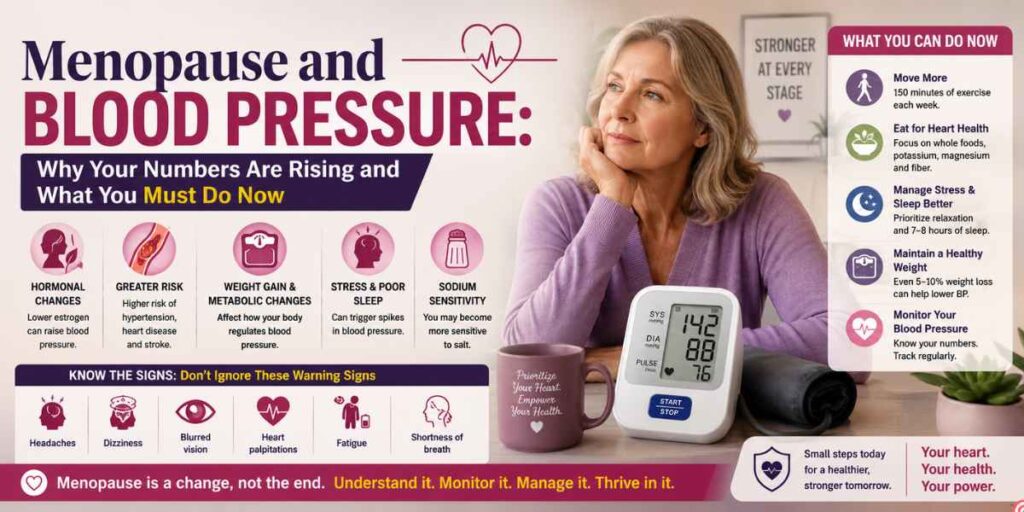
You’ve been healthy your entire life. Your blood pressure has always been “fine.” Then somewhere around your late 40s or early 50s, a routine check reveals a number that stops you in your tracks. Where did this come from?
If you’re a woman going through perimenopause or menopause, there’s a very good chance that your hormones are playing a bigger role in your blood pressure than you realise. The link between falling oestrogen and rising blood pressure is well established in research — yet most women are never told about it. This guide explains exactly what’s happening in your body, whether HRT helps or hinders, and what you can do right now to protect your heart.
Yes — menopause can cause blood pressure to rise. Oestrogen has a vasodilative effect (it helps keep blood vessels relaxed and open). When oestrogen levels drop during perimenopause and menopause, blood vessels become stiffer, sodium retention increases, and blood pressure tends to climb. Research shows that up to 40% of postmenopausal women develop hypertension. The good news: with the right lifestyle changes, monitoring, and — where appropriate — HRT or medication, this is entirely manageable.
📖 In This Guide
- Why Blood Pressure Rises During Menopause
- The Oestrogen Effect: What Your Body Loses
- Perimenopause vs Postmenopause: When Does the Risk Start?
- 5 Hidden Risk Factors That Make It Worse
- HRT and Blood Pressure: Does It Help or Harm?
- Symptoms You Should Never Dismiss as “Just Menopause”
- 8 Evidence-Based Ways to Lower Your Blood Pressure During Menopause
- How to Monitor Your Blood Pressure at Home
- When to See Your GP
- Frequently Asked Questions
1. Why Blood Pressure Rises During Menopause (The Science Nobody Explains)
Before menopause, women have a significant cardiovascular advantage over men. Heart attacks, strokes, and hypertension are all less common in premenopausal women. This isn’t luck — it’s biology. The hormone oestrogen actively protects the cardiovascular system in multiple ways.
When oestrogen levels drop during perimenopause and fall further after menopause, those protective effects are gradually lost. The result is a measurable, well-documented increase in blood pressure that often takes women completely by surprise — especially if their readings have always been normal.
According to Blood Pressure UK and GP menopause specialist Dr Louise Newson, oestrogen plays a direct role in keeping blood pressure down — and when it declines, blood pressure typically rises.
2. The Oestrogen Effect: What Your Body Loses at Menopause
Oestrogen doesn’t just regulate your menstrual cycle. It has oestrogen receptors throughout the entire body — including in the lining of your blood vessels. Here’s what oestrogen does for your cardiovascular system, and what happens when it declines:
Research published in the journal Hypertension shows that up to 40% of postmenopausal women develop high blood pressure. Before menopause, hypertension is far more common in men. After menopause, women not only catch up but can overtake men in prevalence — and their cardiovascular risk rises sharply as a result.
3. Perimenopause vs Postmenopause: When Does the Risk Actually Start?
Many women assume blood pressure only becomes a concern after menopause. In reality, the risk begins rising during perimenopause — the transitional phase that can start 4–10 years before your last period.
A 2021 study from Weill Cornell Medicine found that hypertension during perimenopause may actually be driven by declining oestrogen signalling in the brain’s hypothalamus — suggesting the blood pressure changes can begin before menstruation fully stops.
If you’re in your mid-40s and starting to notice perimenopausal symptoms — irregular periods, hot flushes, sleep disruption — now is the time to establish a baseline blood pressure reading, not wait until after menopause. Early detection gives you the most options.
4. 5 Hidden Risk Factors That Make Menopausal Blood Pressure Worse
Oestrogen decline is the primary driver, but menopause also triggers a cascade of secondary changes that pile on additional blood pressure risk:
1. Weight gain around the middle. Menopause often shifts fat distribution toward the abdomen. Visceral (belly) fat is metabolically active and directly linked to increased insulin resistance and higher blood pressure.
2. Sleep disruption. Night sweats, insomnia, and frequent waking are hallmarks of menopause. Research consistently shows that poor sleep quality independently raises blood pressure — even in people who were previously healthy.
3. Reduced physical activity. Fatigue, joint pain, and low mood during menopause often lead women to exercise less — removing one of the most effective natural blood pressure regulators.
4. Increased salt sensitivity. Postmenopausal women become more sensitive to sodium’s blood-pressure-raising effects than premenopausal women — meaning the same amount of salt in your diet now has a bigger impact.
5. Stress and anxiety. Menopause can coincide with major life stressors — teenage children, ageing parents, career pressures. Chronic stress keeps cortisol and adrenaline elevated, further pushing blood pressure upward.
5. HRT and Blood Pressure: Does It Help or Harm? (The Honest Answer)
This is one of the most debated questions in menopausal healthcare — and the answer is genuinely nuanced.
✅ The Case FOR HRT Helping Blood Pressure
- Oestrogen is vasodilative — replacing it can help blood vessels stay relaxed
- A 2002 study found that postmenopausal women with hypertension who used HRT for a year showed improved circadian blood pressure patterns and reduced arterial stiffness
- HRT can improve sleep quality, reduce hot flushes, and lower stress — all of which indirectly benefit blood pressure
- Dr Louise Newson (menopause specialist) states that high blood pressure is not a contraindication to HRT — women with controlled hypertension can safely take it
⚠️ The Case for Caution
- A 2023 study published in Hypertension (American Heart Association) found that oral oestrogen pills increased the risk of developing high blood pressure by 14% compared to topical (patch/gel) forms
- Conjugated equine oestrogen (an older oral form) carried an 8% higher risk than estradiol (the form that more closely mimics natural oestrogen)
- Higher doses taken for longer periods were associated with greater risk
- Oral HRT passes through the liver, which can increase production of substances that raise blood pressure
📝 The Bottom Line on HRT and Blood Pressure
- Transdermal HRT (patches, gels, sprays) is generally considered safer for blood pressure than oral tablets — it bypasses the liver
- High blood pressure must be controlled first before starting HRT, but it is not a blanket contraindication
- The type, dose, route, and duration of HRT all matter — discuss these with your GP or menopause specialist
- Your blood pressure should be monitored regularly after starting HRT
6. Symptoms You Should Never Dismiss as “Just Menopause”
One of the biggest dangers for menopausal women is that genuine cardiovascular warning signs get blamed on menopause and ignored. Many symptoms of high blood pressure overlap with menopause symptoms — making it easy to dismiss something serious.
If you’re experiencing persistent headaches, heart palpitations, dizziness, or shortness of breath during menopause, don’t assume it’s “just hormones.” Get your blood pressure checked. A 5-minute reading could reveal a problem that’s been silently building. Call 999 if you experience severe chest pain, sudden vision loss, confusion, or weakness on one side of the body.
7. 8 Evidence-Based Ways to Lower Blood Pressure During Menopause
Related: 8 Diet Changes That Actually Lower Blood Pressure
Evidence-based dietary shifts that are especially effective during and after menopause.
📈 Track Your Numbers Through Menopause
Average multiple readings to see the real trend, not just a single snapshot.
8. How to Monitor Your Blood Pressure at Home
Home monitoring is especially important during menopause because your readings may fluctuate more than they used to. The NICE guidelines recommend taking two readings in the morning and two in the evening, sitting quietly for 5 minutes first, for at least 4–7 days. Discard the first day’s readings and average the rest.
Use a BIHS-validated upper arm monitor (not a wrist monitor). Keep a log of your readings, the date, time, and any symptoms — this data is invaluable for your GP.
Related: How to Work Out Your Average Blood Pressure
Step-by-step guide to calculating your true average from home readings.
9. When to See Your GP
Book an appointment if:
- Your home blood pressure readings are consistently at or above 135/85 mmHg
- You’re experiencing persistent headaches, palpitations, or dizziness that you’ve been attributing to menopause
- You’re considering starting HRT and want to discuss the safest route for your cardiovascular health
- You’re already on HRT and have noticed a change in your blood pressure readings
- You have a family history of heart disease or stroke and are approaching menopause
- You had high blood pressure during pregnancy (pre-eclampsia or gestational hypertension) — this increases your long-term risk
Ask your GP specifically about cardiovascular risk assessment at your menopause review. Many women’s menopause consultations focus entirely on symptoms like hot flushes and sleep — blood pressure often gets overlooked unless you raise it yourself.
10. Frequently Asked Questions
Does menopause cause high blood pressure?
Yes. The decline in oestrogen during menopause leads to stiffer blood vessels, increased sodium retention, and changes in how the nervous system regulates blood pressure. Research shows up to 40% of postmenopausal women develop hypertension.
Can HRT lower blood pressure?
Transdermal HRT (patches, gels, sprays) may have a neutral or slightly positive effect on blood pressure by bypassing the liver. However, oral oestrogen tablets can increase blood pressure risk by approximately 14% compared to topical forms. The type, dose, and route all matter — discuss with your GP or menopause specialist.
Can I take HRT if I already have high blood pressure?
Yes — high blood pressure is not a contraindication to HRT, according to menopause specialists. However, your blood pressure must be controlled first before starting HRT. Transdermal forms are preferred over oral tablets, and your GP should monitor your readings regularly after starting treatment.
At what age does blood pressure start rising in women?
Blood pressure typically begins to rise during perimenopause, which can start from the mid-40s. The most significant increases usually occur in the years immediately following menopause (average age 51 in the UK). By age 65, women’s blood pressure often equals or exceeds men’s.
Are hot flushes a sign of high blood pressure?
Hot flushes are primarily a symptom of hormonal changes during menopause, not high blood pressure directly. However, some research suggests that women who experience severe hot flushes may have a higher cardiovascular risk profile. If you’re having frequent or severe hot flushes, it’s worth having your blood pressure checked as part of a broader health review.
Will my blood pressure go back down after menopause?
Unfortunately, no — not on its own. Once oestrogen levels have declined permanently, the cardiovascular protection does not return without intervention. However, lifestyle changes, medication (where needed), and appropriate HRT can all help manage blood pressure effectively for the long term.