It’s 7am. You reach for your first coffee. Then another mid-morning. Maybe a third after lunch. By the time you check your blood pressure at your GP appointment, you’ve had three cups — and your reading is higher than expected. Coincidence? Or did the coffee push your numbers up?
The relationship between caffeine and blood pressure is one of the most commonly asked — and most commonly misunderstood — health questions. The short answer is yes, caffeine does raise blood pressure. But the full picture is more nuanced: how much it raises it, how long the effect lasts, whether it matters if you’re a regular drinker, and what it means for people already on medication — these are the details that actually determine whether your morning coffee is a problem or perfectly fine.
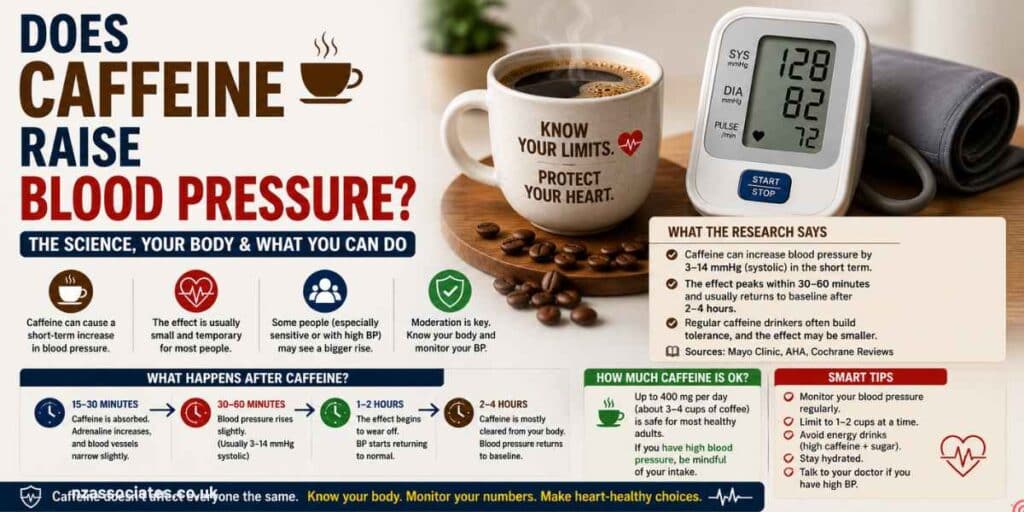
Caffeine raises blood pressure temporarily — by approximately 5–10 mmHg systolic and 3–6 mmHg diastolic — within 30–60 minutes of consumption. The effect typically lasts 3–4 hours. Regular coffee drinkers develop partial tolerance, so the spike is usually smaller. The NHS recommends limiting caffeine to 400mg per day (roughly 4 standard cups of coffee). For most people, moderate coffee intake does not cause long-term hypertension — but if you have existing high blood pressure, the temporary spikes matter more.
📖 In This Guide
- What Caffeine Actually Does to Your Blood Pressure
- The Exact Numbers: How Much Does Caffeine Raise BP?
- Regular vs Occasional Drinkers: The Tolerance Effect
- How Much Caffeine Is in Your Drink? (UK Comparison Table)
- Does Coffee Cause Long-Term Hypertension?
- If You Already Have High Blood Pressure: What to Know
- Caffeine and Blood Pressure Medication
- Should You Skip Coffee Before a Blood Pressure Check?
- Frequently Asked Questions
1. What Caffeine Actually Does to Your Blood Pressure
Caffeine affects blood pressure through several mechanisms, all working simultaneously:
- Blocks adenosine receptors: Adenosine is a chemical that normally helps your blood vessels relax and dilate. Caffeine blocks these receptors, preventing relaxation — so your blood vessels stay constricted, which raises pressure.
- Stimulates adrenaline release: Caffeine triggers your adrenal glands to produce more adrenaline (epinephrine), which increases heart rate and constricts blood vessels — the same fight-or-flight response that stress causes.
- Increases cardiac output: Your heart beats slightly faster and with more force after caffeine intake, pushing more blood through already-constricted vessels.
The result: within 30–60 minutes of your coffee, both systolic and diastolic blood pressure rise. The peak effect typically occurs around 60–90 minutes after consumption, then gradually wears off over the next 3–4 hours.
That mental sharpness you feel after coffee isn’t just about brain stimulation — it’s partly the result of increased blood pressure pushing more blood (and therefore more oxygen) to your brain. The boost in alertness and the rise in blood pressure are two sides of the same physiological coin.
2. The Exact Numbers: How Much Does Caffeine Raise Blood Pressure?
Clinical research gives us remarkably specific data. A meta-analysis of controlled trials published in the American Journal of Clinical Nutrition found that a caffeine dose of 200–300mg (roughly 2–3 cups of coffee) produced:
Source: Mesas et al., American Journal of Clinical Nutrition, 2011 — meta-analysis of controlled trials in hypertensive individuals.
To put that in perspective: an 8 mmHg systolic increase could push a borderline reading of 134/84 up to 142/90 — crossing the NHS hypertension threshold. For someone with already-high blood pressure, this is clinically meaningful. For someone with normal readings, it’s a temporary blip that settles within hours.
If you drink coffee every 3–4 hours — a morning cup, a mid-morning cup, and a lunchtime cup — the effect from each dose may overlap before the previous one has fully worn off. This means your blood pressure could be elevated above baseline for most of the working day, even though each individual cup only raises it temporarily.
3. Regular vs Occasional Drinkers: The Tolerance Effect
Here’s the good news for daily coffee drinkers: your body develops partial tolerance to caffeine’s blood pressure effect over 1–2 weeks of regular consumption.
However, tolerance is partial, not complete. Even habitual coffee drinkers show measurably higher blood pressure on days they drink coffee compared to days they don’t — the effect is just smaller than it would be for a non-regular drinker.
4. How Much Caffeine Is in Your Drink? (UK Comparison Table)
Not all caffeine sources are equal. Knowing what’s in your drink helps you stay within the NHS recommended limit of 400mg per day:
A “large” coffee from Costa, Starbucks, or Nero often contains 2–3 espresso shots — that’s 150–225mg of caffeine in a single drink. Two large coffees from a chain = 300–450mg — already at or beyond the daily limit. If you grab a large latte on the way to work and another at lunch, you may be consuming far more caffeine than you realise.
5. Does Coffee Cause Long-Term Hypertension? (The Honest Answer)
This is where the science gets genuinely interesting — and where most articles oversimplify.
The short-term effect is clear: caffeine raises blood pressure temporarily. No serious dispute about this.
The long-term picture is more reassuring: multiple large-scale studies — including a major meta-analysis of over 170,000 participants — have found that habitual coffee consumption is not associated with an increased risk of developing chronic hypertension. In some studies, moderate coffee drinkers (3–4 cups daily) actually showed slightly lower cardiovascular risk than non-drinkers, though researchers caution this may reflect other lifestyle factors rather than a direct protective effect of coffee.
The likely explanation: tolerance develops to the acute blood pressure effect, and coffee contains hundreds of other bioactive compounds (including polyphenols and chlorogenic acids) that may have beneficial effects on blood vessel function over time.
For most healthy adults, moderate coffee consumption (3–4 cups per day, within 400mg caffeine) does not appear to cause lasting hypertension. The temporary spikes are real but settle. However, this reassurance applies to habitual moderate drinkers — not to people consuming excessive amounts, or to those who already have uncontrolled high blood pressure.
6. If You Already Have High Blood Pressure: What You Need to Know
If your blood pressure is already elevated, caffeine’s temporary spikes become more clinically meaningful. Here’s why:
- If your resting BP is 138/88 and caffeine adds 8/6 mmHg, you’re temporarily sitting at 146/94 — well into Stage 1 Hypertension territory for several hours
- Repeated daily caffeine-induced spikes mean your arteries are exposed to higher pressure for a significant portion of each day
- Caffeine can partially counteract the effect of blood pressure medication, making it harder for your GP to achieve your target readings
If you have high blood pressure and want to know how much caffeine affects your readings specifically, try this: check your blood pressure before your first coffee, then again 60 minutes after. If the difference is more than 10 mmHg systolic, caffeine is having a significant impact on your numbers. Discuss this with your GP — they may recommend reducing intake or switching to decaf.
7. Caffeine and Blood Pressure Medication
Caffeine doesn’t directly interact with most blood pressure medications in a dangerous pharmacological way. However, it can functionally counteract their effect — working against the medication’s goal of keeping your numbers low.
If you’re taking medication to bring your blood pressure from 150/95 down to below 140/90, and caffeine is adding 5–8 mmHg on top of your treated reading for several hours each day, your medication may appear to be “not working” — when in reality, it’s working fine but caffeine is offsetting part of its effect.
Practical approach: Most GPs will not tell you to stop coffee entirely. Instead, they may suggest limiting to 1–2 cups per day, switching to decaf or tea (lower caffeine), and taking your morning blood pressure reading before your first coffee to get a true baseline.
Related: Blood Pressure Medications — Types, Side Effects & What to Expect
Full guide including drug and food interactions.
8. Should You Skip Coffee Before a Blood Pressure Check?
Yes. Both the NHS and the British Heart Foundation recommend avoiding caffeine for at least 30 minutes (ideally 1 hour) before taking a blood pressure reading — whether at home or at your GP surgery.
If you drink coffee before a GP check and your reading comes back high, there’s no way to know whether that’s your true baseline or a caffeine-inflated number. This can lead to unnecessary further testing, anxiety, or even a premature hypertension diagnosis.
For home monitoring, the NICE protocol recommends taking morning readings before food, caffeine, and medication — giving you the most accurate baseline possible.
📈 See How Caffeine Affects Your Average
Log your pre-coffee and post-coffee readings in our free calculator to see the true difference caffeine makes to your numbers.
9. Frequently Asked Questions
Does caffeine raise blood pressure permanently?
No. Caffeine’s effect on blood pressure is temporary, typically lasting 3–4 hours per dose. Large-scale studies have not found an association between habitual moderate coffee consumption and the development of chronic hypertension. However, very heavy consumption (6+ cups daily) may contribute to sustained elevation due to overlapping doses.
How long after coffee does blood pressure go back to normal?
Blood pressure typically returns to baseline within 3–4 hours after a single cup of coffee. The peak effect occurs around 60–90 minutes after consumption. If you drink multiple cups throughout the day, the effects may overlap, keeping blood pressure elevated for longer.
Is tea better than coffee for blood pressure?
Tea contains roughly half the caffeine of coffee (40–70mg per cup vs 95–140mg), so its blood pressure effect is proportionally smaller. Some research also suggests that tea’s L-theanine content may partially counteract caffeine’s pressor effect. If you’re looking to reduce caffeine’s impact on your BP, switching from coffee to tea is a reasonable step — though it won’t eliminate the effect entirely.
Should I stop drinking coffee if I have high blood pressure?
You don’t necessarily need to stop entirely. Most GPs will recommend limiting to 1–2 cups per day and avoiding caffeine before blood pressure readings. If your home readings show a significant difference between pre-coffee and post-coffee numbers (more than 10 mmHg systolic), reducing intake or switching to decaf may help your medication work more effectively.
How much caffeine is safe per day?
The NHS recommends no more than 400mg of caffeine per day for most adults. This is roughly equivalent to 4 standard cups of filter coffee, 5–6 cups of instant coffee, or 8 cups of tea. Pregnant women should limit to 200mg per day. For people with high blood pressure, staying under 200–300mg may be advisable — discuss with your GP.
Do energy drinks raise blood pressure more than coffee?
Energy drinks can have a more pronounced effect because they often combine caffeine with other stimulants like taurine and guarana, plus high sugar content. A single 500ml energy drink can contain 160mg+ of caffeine — equivalent to nearly two cups of instant coffee. The combination of stimulants may produce a larger blood pressure spike than the same amount of caffeine from coffee alone.
Does decaf coffee raise blood pressure?
Decaf coffee contains a small amount of residual caffeine (typically 2–15mg per cup vs 95–140mg in regular coffee), so its effect on blood pressure is minimal to negligible. If you enjoy the taste and ritual of coffee but want to eliminate the blood pressure impact, decaf is a practical alternative.