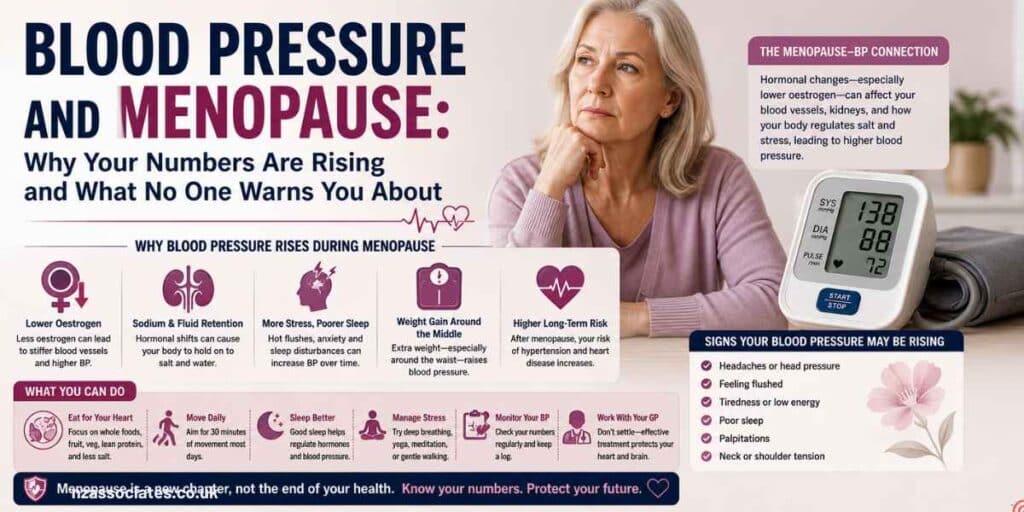
You’ve always had healthy blood pressure. Your readings were fine at 35, fine at 40, fine at 45. Then suddenly — somewhere around your late forties or early fifties — the numbers start creeping up. Your GP raises an eyebrow. You’re prescribed tablets you never expected to need. And nobody connects the dots to what’s really going on: menopause.
This is one of the most overlooked — and most important — health shifts women face. The protective effect of oestrogen on your heart and blood vessels doesn’t fade gently; it drops away, leaving your cardiovascular system exposed in ways it has never been before. Yet most women are never warned about this, and many GPs don’t routinely discuss blood pressure during menopause consultations. This guide changes that.
Yes — menopause directly contributes to rising blood pressure. Declining oestrogen levels cause blood vessels to stiffen, sodium retention to increase, and the cardiovascular protective effects women relied on for decades to diminish. Research shows postmenopausal women experience a systolic rise of approximately 4–5 mmHg beyond normal ageing, and by age 65, women’s blood pressure often overtakes men’s. The good news: early monitoring, lifestyle changes, and — where appropriate — HRT can make a significant difference.
📖 In This Guide
- Why Blood Pressure Rises During Menopause
- The Oestrogen Effect: What You Lose and When
- How Much Does Menopause Actually Raise Blood Pressure?
- 4 Hidden Cardiovascular Risks Menopause Triggers
- Menopause Symptoms vs Blood Pressure Symptoms: How to Tell the Difference
- HRT and Blood Pressure: The Truth Behind the Confusion
- 7 Proven Ways to Protect Your Blood Pressure Through Menopause
- Why Home Monitoring Matters More Than Ever After 45
- What to Ask Your GP
- Frequently Asked Questions
1. Why Blood Pressure Rises During Menopause (The Science Most Women Are Never Told)
For most of adult life, women enjoy a cardiovascular advantage over men. Premenopausal women consistently have lower average blood pressure, lower rates of heart disease, and better arterial flexibility. This isn’t luck — it’s biology. And the key player is oestrogen.
When oestrogen levels begin to decline during perimenopause (typically between ages 45–55), that protective shield drops away — not gradually, but in a relatively sharp hormonal shift that your cardiovascular system was never designed to handle without support.
Here is what happens inside your body:
- Blood vessels lose flexibility: Oestrogen helps keep arterial walls supple and elastic. Without it, they stiffen — a process called arterial stiffening — which directly increases systolic blood pressure.
- Nitric oxide production falls: Oestrogen stimulates the production of nitric oxide, a molecule that relaxes and widens blood vessels. Less oestrogen means less nitric oxide, meaning narrower, tighter arteries.
- Sodium retention increases: The hormonal shift causes the kidneys to retain more sodium and water, increasing blood volume and pressure.
- Sympathetic nervous system becomes more active: The “fight-or-flight” system becomes more reactive, contributing to higher resting blood pressure and greater variability in readings.
- Weight redistribution: Menopause often triggers a shift in body fat from hips and thighs to the abdomen. Central (abdominal) fat is strongly linked to insulin resistance and higher blood pressure.
The risk of heart attack is five times higher after menopause than before. According to Blood Pressure UK, cardiovascular disease is now the leading cause of death for women in the UK — overtaking all cancers combined. Yet many women focus on cancer screening while overlooking their blood pressure entirely.
2. The Oestrogen Effect: What You Lose and When It Starts to Matter
Oestrogen is not just a reproductive hormone — it is a cardiovascular protector. Throughout your reproductive years, it performs several critical functions that most women are never told about:
This process begins during perimenopause — typically 4–8 years before periods stop completely — meaning blood pressure can start rising well before you reach “official” menopause. Many women don’t connect rising readings to hormonal changes because they’re still having periods.
If your blood pressure has started to creep up since your mid-forties and you’re also experiencing hot flushes, night sweats, mood changes, or irregular periods, there is a strong possibility these are all part of the same hormonal picture. Mention menopause when discussing blood pressure with your GP — many clinicians still treat them as separate issues.
3. How Much Does Menopause Actually Raise Blood Pressure? (The Data)
It’s not just “getting older.” Research has isolated the specific effect of menopause — separate from normal ageing — on blood pressure. Here is what large-scale studies have found:
- A prospective cohort study published in the Journal of Human Hypertension found that systolic blood pressure rose approximately 4–5 mmHg in women going through perimenopause and menopause — above and beyond the normal age-related increase. This effect was specific to systolic pressure and was not observed in men of the same age.
- The Italian Progetto Menopausa study of over 45,000 women found that postmenopausal women had a 14% higher odds of hypertension compared to perimenopausal women of the same age and BMI.
- UK Biobank data shows that by age 65, women’s average systolic blood pressure exceeds men’s — a complete reversal from the pattern seen before menopause.
Related: Normal Blood Pressure by Age — Complete Chart for Men & Women
See exactly how average readings change decade by decade.
4. 4 Hidden Cardiovascular Risks Menopause Triggers (Beyond Blood Pressure)
Rising blood pressure is not the only cardiovascular change menopause brings. These four risks compound the damage — and most women don’t know about them until something goes wrong.
Risk #1: Cholesterol shift. Falling oestrogen causes LDL (“bad”) cholesterol to rise and HDL (“good”) cholesterol to fall. This accelerates plaque buildup in arteries — adding to the damage already being caused by stiffening vessels and rising blood pressure.
Risk #2: Insulin resistance. Hormonal changes make the body less sensitive to insulin, increasing the likelihood of developing type 2 diabetes — which itself is one of the strongest risk factors for hypertension and heart disease.
Risk #3: Increased blood pressure variability. Research shows that postmenopausal women experience greater blood pressure variability — more swings between high and low throughout the day. This variability is itself an independent cardiovascular risk factor, separate from average blood pressure levels.
Risk #4: Weight gain and redistribution. The average woman gains 2–5 kg during the menopausal transition, and even without weight gain, fat tends to shift from the hips to the abdomen. Central (visceral) fat is metabolically active and directly contributes to higher blood pressure, higher cholesterol, and higher blood sugar.
These risks don’t arrive one at a time — they arrive together, compounding each other. A woman going through menopause may simultaneously develop higher blood pressure, worse cholesterol, increased insulin resistance, and more abdominal fat. This cluster of changes is sometimes called the “cardiovascular cliff” of menopause, and it’s the primary reason heart disease risk escalates so sharply.
5. Menopause Symptoms vs Blood Pressure Symptoms: How to Tell the Difference
One of the most dangerous aspects of this overlap is that menopause symptoms and high blood pressure symptoms can look almost identical — meaning dangerous blood pressure levels can be dismissed as “just menopause.”
If you’re experiencing headaches, palpitations, or dizziness and putting it down to menopause — check your blood pressure. The only way to know whether these symptoms are hormonal, cardiovascular, or both is to measure your numbers. A reading above 140/90 mmHg needs medical attention regardless of whether you are also going through menopause.
6. HRT and Blood Pressure: The Truth Behind the Confusion
There has been enormous confusion — among women and some clinicians — about whether HRT (Hormone Replacement Therapy) is safe for women with high blood pressure. Here is what the evidence actually shows:
The Key Distinction: Transdermal vs Oral HRT
- Transdermal oestrogen (patches, gels, sprays) is neutral on blood pressure — it does not raise it, and may actually help lower it. The British Menopause Society confirms that transdermal HRT is suitable for women with hypertension.
- Oral oestrogen (tablets) passes through the liver before entering the bloodstream, which can trigger changes in clotting factors and, in some cases, raise blood pressure. This route is generally less preferred for women with existing hypertension.
Having high blood pressure is NOT a reason to refuse HRT. According to Blood Pressure UK and the British Menopause Society, body-identical transdermal HRT is suitable for women with high blood pressure or those already taking blood pressure medications. Some women are still being needlessly advised against HRT by clinicians working from outdated information. If this has happened to you, consider seeking a second opinion — ideally from a menopause-trained GP or specialist.
Research also suggests that starting HRT within 10 years of menopause is associated with a lower risk of coronary heart disease compared to women who don’t take it — what’s known as the “window of opportunity.” Starting later still offers benefits for most women, but the cardiovascular protection is strongest when started early.
7. 7 Proven Ways to Protect Your Blood Pressure Through Menopause
Menopause changes the rules — but it doesn’t take away your ability to influence the outcome. These strategies are specifically relevant to the cardiovascular changes happening during this transition:
Related: 8 Diet Changes That Actually Lower Blood Pressure
Evidence-based dietary shifts with exact data on how much each one moves the needle.
8. Why Home Monitoring Matters More Than Ever After 45
If there is one piece of practical advice that every woman approaching or going through menopause should take seriously, it is this: start monitoring your blood pressure at home.
Here’s why home monitoring is especially critical during menopause:
- BP variability increases after menopause — a single GP reading may catch you on a “good” day and miss the bigger picture
- Masked hypertension (normal at the GP, high at home) is more common in stressed, perimenopausal women
- White coat hypertension can lead to unnecessary medication if your GP relies solely on clinic readings
- Tracking trends over weeks and months reveals the gradual climb that a once-a-year check misses entirely
📈 Are Your Numbers Changing?
Enter your home readings over several days and see your true average — not just today’s snapshot.
9. What to Ask Your GP: 5 Questions Every Woman Over 45 Should Raise
- “Could my rising blood pressure be related to perimenopause or menopause?” — Force the connection if your GP hasn’t made it.
- “Should I have my cholesterol, blood sugar, and kidney function checked alongside my blood pressure?” — These risks compound together.
- “Is HRT safe for me, and if so, which type — patches, gel, or tablets?” — Transdermal is safe with hypertension; oral may not be ideal.
- “Should I do home blood pressure monitoring, and for how long?” — The answer should almost always be yes from age 45 onward.
- “What is my 10-year cardiovascular risk score?” — Your GP can calculate this using QRISK3, which factors in age, BP, cholesterol, diabetes status, and more.
10. Frequently Asked Questions
Does menopause directly cause high blood pressure?
Yes. Declining oestrogen levels during menopause cause blood vessels to stiffen, reduce nitric oxide production, and increase sodium retention — all of which directly raise blood pressure beyond what normal ageing alone would cause. Studies show an additional systolic rise of approximately 4–5 mmHg attributable to menopause itself.
Can I take HRT if I have high blood pressure?
Yes — transdermal HRT (patches, gels, and sprays) is safe for women with high blood pressure. The British Menopause Society and Blood Pressure UK both confirm this. Oral oestrogen tablets may not be ideal as they can affect clotting factors and, in some cases, raise blood pressure. Discuss with a menopause-trained GP for personalised advice.
At what age does blood pressure start rising in women?
Blood pressure can begin rising during perimenopause, typically between ages 45 and 55 — often several years before periods stop completely. By age 65, women’s average blood pressure typically exceeds men’s.
Does HRT lower blood pressure?
Transdermal oestrogen is generally neutral on blood pressure — it does not raise it and may help lower it by improving blood vessel flexibility. It is not prescribed as a blood pressure treatment, but it can contribute to better cardiovascular health overall when used as part of menopausal HRT.
Why is heart disease risk higher after menopause?
Oestrogen protects blood vessels, maintains healthy cholesterol levels, and supports insulin sensitivity. When these protective effects diminish, women face rising blood pressure, worsening cholesterol, increased insulin resistance, and a shift in body fat toward the abdomen — a cluster of changes that dramatically increases cardiovascular risk. Heart attacks are five times more common after menopause than before.
How can I tell if my symptoms are menopause or high blood pressure?
Many symptoms overlap — headaches, palpitations, dizziness, and flushing can be caused by either menopause or high blood pressure (or both). The only reliable way to distinguish them is to measure your blood pressure. If your reading is consistently above 140/90 mmHg, the symptoms need medical investigation regardless of their hormonal connection.