You’ve had a long week. You pour yourself a glass of wine — or maybe two — and feel yourself relax. Your shoulders drop. Your breathing slows. Surely that’s lowering your blood pressure, right?
Not exactly. What alcohol does to your blood pressure is more complicated — and more counterintuitive — than most people realise. In the first hour, it may actually cause a slight drop. But after that initial dip, the rebound kicks in. And if drinking becomes a regular pattern, the long-term effects on your cardiovascular system are clear, consistent, and well-documented.
Yes — alcohol raises blood pressure. A single drink may cause a temporary drop followed by a rebound rise. Regular drinking above the NHS guideline of 14 units per week is strongly linked to sustained hypertension. Heavy drinking can raise systolic blood pressure by 5–10 mmHg on average. Cutting back can lower your reading by 2–4 mmHg within 1–2 weeks — one of the fastest-acting lifestyle changes available. The type of alcohol (beer, wine, spirits) matters far less than the quantity.
📖 In This Guide
- What Happens to Your Blood Pressure When You Drink
- How Much Does Alcohol Actually Raise Blood Pressure?
- The NHS 14-Unit Rule (With Real Drink Examples)
- Beer vs Wine vs Spirits: Does the Type of Drink Matter?
- Binge Drinking: Why One Big Night Is Worse Than You Think
- Alcohol and Blood Pressure Medication: A Risky Mix
- What Happens When You Cut Back (Timeline)
- Frequently Asked Questions
1. What Happens to Your Blood Pressure When You Drink
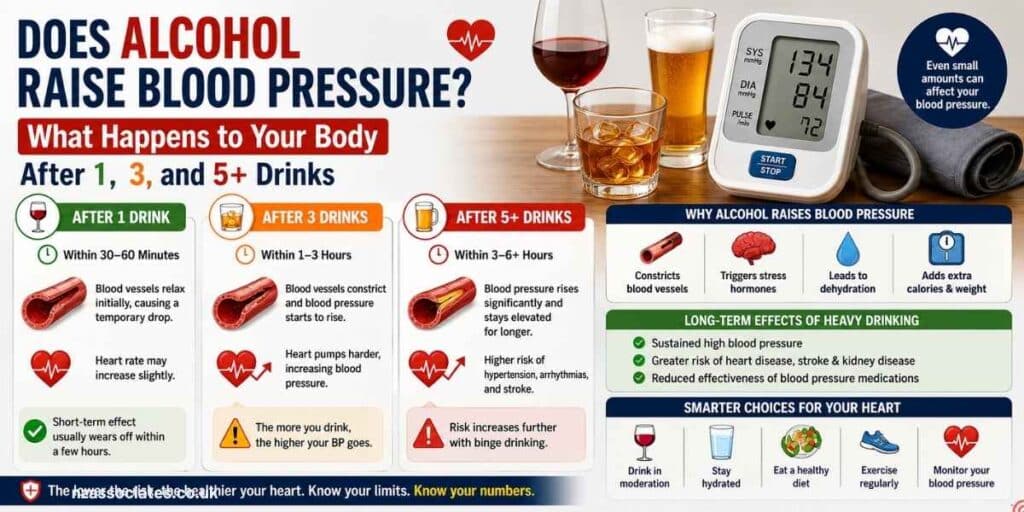
Alcohol’s effect on blood pressure unfolds in two phases — and the second one is the one that causes the damage.
Phase 1: The Initial Dip (First 1–6 Hours)
In the first few hours after drinking, alcohol acts as a vasodilator — it relaxes and widens your blood vessels. This causes a temporary fall in blood pressure, which is partly why you may feel warm, flushed, and relaxed after a drink. Your heart rate may also increase slightly to compensate for the wider blood vessels.
This initial drop is what leads many people to believe alcohol is good for blood pressure. It isn’t — because of what comes next.
Phase 2: The Rebound Rise (6–24 Hours After Drinking)
As your body metabolises the alcohol, blood pressure doesn’t just return to normal — it overshoots. Your sympathetic nervous system (the fight-or-flight system) ramps up to compensate for the earlier dip. Cortisol and adrenaline levels rise. Blood vessels constrict. The result: blood pressure climbs above your normal baseline for several hours, sometimes not fully settling until the following day.
This rebound effect is why morning-after blood pressure readings are often the highest of the day for regular drinkers — and why people who drink frequently may show persistently elevated readings even when they feel fine.
Many people take their blood pressure in the evening while drinking and see a normal or even low reading — then assume alcohol is harmless. The damage happens later, during the rebound phase, when they’re asleep or not checking. If you drink regularly, try measuring your blood pressure the morning after — that’s when the true impact becomes visible.
2. How Much Does Alcohol Actually Raise Blood Pressure? (The Numbers)
Research gives us reasonably clear dose-response data:
According to the British Heart Foundation, regularly drinking above the recommended limit is one of the leading modifiable risk factors for hypertension — alongside salt intake, obesity, and physical inactivity.
3. The NHS 14-Unit Rule: What Does That Actually Look Like?
The NHS recommends no more than 14 units of alcohol per week, spread over at least 3 days, with several alcohol-free days in between. But “14 units” is surprisingly easy to exceed if you don’t know what a unit looks like:
A “glass of wine” at home is often a 250ml pour — 3.3 units, not the 175ml standard used in NHS calculations. Two large glasses of wine in an evening = 6.6 units — nearly half your entire weekly allowance in one sitting. Most people dramatically underestimate how many units they actually drink.
4. Beer vs Wine vs Spirits: Does the Type of Drink Matter?
You may have heard that red wine is “heart-healthy” because of antioxidants like resveratrol. Here’s what the science actually says: the amount of alcohol matters far more than the type.
The British Heart Foundation is clear on this point: any potential benefit from resveratrol in red wine is overwhelmed by the harm from the alcohol itself once you exceed moderate levels. You would need to drink unrealistic quantities of red wine to get a meaningful dose of resveratrol — far more than would be safe for your blood pressure or liver.
The bottom line: beer, wine, and spirits all raise blood pressure through the same mechanism — ethanol. The unit count matters; the label on the bottle doesn’t.
5. Binge Drinking: Why One Big Night Is Worse Than You Think
Binge drinking — defined by the NHS as consuming 6+ units in a single session (roughly 2–3 pints of strong lager or 2 large glasses of wine) — creates an acute stress response in your cardiovascular system that goes beyond the effect of the same total units spread across a week.
What happens during a binge:
- Blood pressure can spike by 15–20+ mmHg during the rebound phase
- Heart rhythm can become irregular (atrial fibrillation), sometimes called “holiday heart syndrome”
- The blood pressure elevation can persist for 12–24 hours after the last drink
- Repeated binges cause cumulative arterial damage, even if you abstain between sessions
If you choose to drink, the NHS recommends spreading your 14 units over at least 3 days rather than saving them for one or two big sessions. Having 2 units on 5 different days is significantly less harmful to your blood pressure than having 10 units on a Saturday night — even though the weekly total is similar.
6. Alcohol and Blood Pressure Medication: A Risky Mix
If you’re taking blood pressure medication, alcohol creates a specific additional risk: it can amplify the blood-pressure-lowering effect of your tablets, causing your pressure to drop dangerously low — particularly in the first few hours after drinking.
The most problematic combinations:
- Alpha-blockers (e.g. Doxazosin) + alcohol = high risk of severe postural hypotension (dizziness/fainting on standing)
- Diuretics + alcohol = amplified dehydration effect, increased dizziness, electrolyte imbalance
- Any BP medication + heavy alcohol = unpredictable blood pressure swings (initial crash followed by rebound spike)
This doesn’t mean you can never drink if you’re on blood pressure medication. Most GPs will say that moderate, occasional drinking within the 14-unit guideline is usually acceptable. But heavy drinking or bingeing while on medication creates genuinely unpredictable — and potentially dangerous — blood pressure swings. Always discuss your drinking habits openly with your GP.
Related: Blood Pressure Medications — Types, Side Effects & What to Expect
Full drug interaction guide including alcohol, grapefruit, and NSAIDs.
7. What Happens When You Cut Back: The Recovery Timeline
The good news: alcohol’s effect on blood pressure is largely reversible. Here’s what the evidence shows:
For someone drinking 20+ units per week who reduces to under 14, the blood pressure improvement can be equivalent to starting a new medication — without a single pill.
📈 Track the Difference Cutting Back Makes
Log your readings before and after reducing alcohol. Our free calculator shows your average over time — so you can see the improvement in black and white.
8. Frequently Asked Questions
Does alcohol raise blood pressure immediately?
In the first 1–6 hours, alcohol often causes a temporary dip in blood pressure due to vasodilation. However, this is followed by a rebound rise that can last 12–24 hours, pushing blood pressure above your normal baseline. The net effect over a full day is an increase.
Is red wine better for blood pressure than beer or spirits?
No. The British Heart Foundation is clear that the amount of alcohol matters far more than the type. Any potential benefit from antioxidants in red wine is overwhelmed by the harm from ethanol once you exceed moderate levels. Beer, wine, and spirits all raise blood pressure through the same mechanism.
How long after drinking does blood pressure return to normal?
After a single moderate drinking session, blood pressure typically returns to baseline within 12–24 hours. After heavy or binge drinking, it may take up to 48 hours. For regular heavy drinkers who stop entirely, a measurable improvement is usually visible within 1–2 weeks.
Can I drink alcohol if I’m on blood pressure medication?
Moderate, occasional drinking within the NHS 14-unit guideline is usually considered acceptable for most people on blood pressure medication. However, heavy drinking or bingeing can cause dangerous blood pressure swings — amplifying the medication’s effect initially, then causing a rebound spike. Always discuss your drinking habits with your GP.
How much does cutting out alcohol lower blood pressure?
Reducing alcohol intake from above the guideline to within it typically lowers systolic blood pressure by 2–4 mmHg within 1–2 weeks. For heavy drinkers who significantly reduce or stop entirely, the effect can be larger — sometimes equivalent to adding a blood pressure medication.
What is the NHS recommended alcohol limit?
The NHS recommends no more than 14 units of alcohol per week for both men and women, spread over at least 3 days, with several alcohol-free days in between. This is equivalent to roughly 6 pints of standard lager, 6 standard glasses of wine, or 14 single measures of spirits.
Should I avoid alcohol completely if I have high blood pressure?
Complete abstinence is not required for most people with high blood pressure, unless your GP specifically advises it. Staying within the 14-unit guideline, avoiding binge drinking, and spreading your intake across the week is the most practical and evidence-backed approach. However, if you are struggling to stay within limits, stopping entirely may be the simplest strategy.