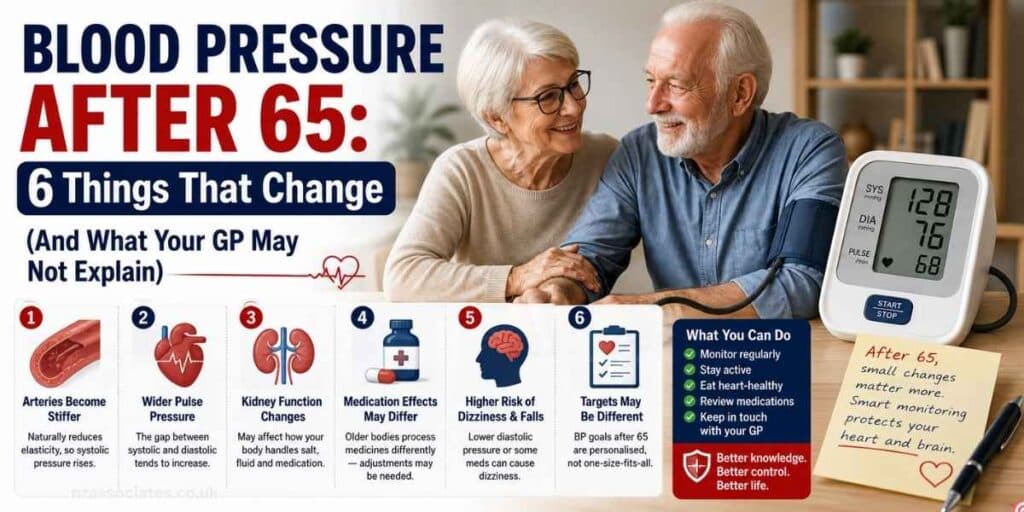
If you’re over 65 and your blood pressure readings look different from what they used to be, you’re not imagining things. Blood pressure genuinely behaves differently in older adults — the numbers shift, the risks change, the treatment targets adjust, and some of the advice that applies to younger people can actually become dangerous for you.
Yet most blood pressure guides online are written for a generic “adult” audience and barely mention the realities of managing blood pressure in your 60s, 70s, and beyond. This guide is specifically for you — whether you’re navigating your own readings or helping an older family member understand theirs.
After 65, blood pressure management changes in several important ways. Systolic pressure (top number) typically rises due to arterial stiffening, while diastolic (bottom number) often falls — creating a wide gap that’s an independent risk factor. The NHS treatment target for most adults over 65 is below 140/90 mmHg, but for adults over 80, a more relaxed target of below 150/90 mmHg may be used, especially if frailty or fall risk is a concern. Crucially, pushing diastolic too low (below 60 mmHg) through aggressive medication can be more dangerous than a slightly elevated systolic reading.
📖 In This Guide
- 6 Things That Change About Blood Pressure After 65
- What Should Your Blood Pressure Be? (NHS Targets by Age)
- Isolated Systolic Hypertension: The Most Common Pattern After 65
- When Treatment Goes Too Far: The Danger of Low Blood Pressure in Seniors
- Blood Pressure Medication After 65: What’s Different
- Postural Hypotension: Why You Feel Dizzy Standing Up
- Lifestyle Changes That Still Work After 65
- Home Monitoring for Seniors: Practical Tips
- Frequently Asked Questions
1. 6 Things That Change About Blood Pressure After 65
Change #1: Systolic rises, diastolic falls.
After about age 55–60, your large arteries gradually stiffen. Stiff arteries can’t absorb each heartbeat’s force as smoothly, so systolic (top number) climbs. At the same time, diastolic (bottom number) often falls because stiff arteries recoil poorly between beats. The result: readings like 158/62 instead of the classic 140/90.
Change #2: The gap between your numbers widens.
This widening gap — called pulse pressure — becomes an independent cardiovascular risk factor. A pulse pressure above 60 mmHg is associated with higher rates of heart attack, stroke, and atrial fibrillation in older adults, even when neither individual number looks dramatic on its own.
Change #3: Blood pressure becomes more variable.
Day-to-day readings can swing more dramatically in older adults. You might see 148/72 in the morning and 126/68 in the evening. This variability itself is a cardiovascular risk factor — not just the average level.
Change #4: Postural drops become more common.
Standing up quickly can cause blood pressure to plummet — a condition called orthostatic (postural) hypotension. It’s more common in seniors due to slower baroreceptor reflexes, medication effects, and dehydration. It causes dizziness, unsteadiness, and falls — a major health risk for older adults.
Change #5: Treatment targets may relax.
For most adults, the NHS targets below 140/90 mmHg. But for adults over 80, NICE guidelines allow a more relaxed target of below 150/90 mmHg — recognising that aggressive treatment carries increasing risks (falls, low diastolic, kidney problems) as you age and become frailer.
Change #6: “Lower is better” stops being true.
In younger adults, lower blood pressure is almost always safer. In older adults, pushing blood pressure too low — particularly diastolic below 60 mmHg — can actually increase cardiac risk by reducing blood flow to the heart muscle. This is the “J-curve” phenomenon, and it’s one of the most important concepts in senior blood pressure management.
Managing blood pressure after 65 isn’t just about getting numbers down. It’s about finding the safe middle ground — low enough to protect against stroke and heart attack, but not so low that you’re falling over, feeling faint, or starving your heart muscle of blood. This balance is individual, and it’s why your GP should review your medication regularly as you age.
2. What Should Your Blood Pressure Be? (NHS Targets by Age Group)
Source: NICE guideline NG136 — Hypertension in adults: diagnosis and management.
Typical Average Blood Pressure Readings by Age
A well-meaning relative might say “138/78 is perfectly normal at your age.” Clinically, this reading is in the High-Normal zone regardless of age. The NHS treatment threshold (140/90) does not change with age — “average” and “target” are different things. Always discuss your personal target with your GP.
Related: Normal Blood Pressure by Age — Complete Chart
Detailed interactive breakdown by decade, with separate ranges for men and women.
3. Isolated Systolic Hypertension: The Most Common Pattern After 65
Isolated systolic hypertension (ISH) — where the top number is 140+ but the bottom number is below 90 — affects up to 80% of hypertensive adults over 65. It is overwhelmingly the dominant pattern in this age group.
Why it’s tricky to treat: The medication challenge with ISH is that all blood pressure drugs lower both numbers. To bring a systolic of 162 down to 140, medication may push a diastolic of 64 down to 48 — which enters the danger zone for coronary blood flow. This is the central dilemma of blood pressure management in older adults, and it’s why your GP may accept a slightly higher systolic to protect your diastolic floor.
Related: Low Diastolic Blood Pressure — Causes & When to Worry
The J-curve danger, medication over-treatment, and when low diastolic becomes risky.
4. When Treatment Goes Too Far: The Real Danger of Low Blood Pressure in Seniors
In younger adults, the rule is simple: lower blood pressure = lower risk. After 65, this equation breaks down. Research consistently shows a “J-curve” — below a diastolic of approximately 60–70 mmHg, cardiovascular risk actually starts climbing upward again, particularly in people with existing coronary artery disease.
The practical risks of over-treated low blood pressure in seniors:
- Falls — the most immediate danger. Dizziness from low BP leads to falls, which cause hip fractures, head injuries, and loss of independence. Falls are the leading cause of injury-related death in UK adults over 65.
- Reduced coronary blood flow — the heart muscle itself receives blood during diastole. Diastolic below 60 mmHg can starve the heart of oxygen.
- Cognitive decline — chronic low blood pressure in the elderly is associated with reduced brain perfusion and faster cognitive deterioration.
- Kidney damage — the kidneys need adequate pressure to filter blood effectively.
- Fatigue and withdrawal — persistent tiredness and weakness lead to reduced activity, social isolation, and declining quality of life.
If you’re over 65 and on blood pressure medication, ask: “Is my diastolic (bottom number) getting too low?” If it’s consistently below 60, a medication review may be needed. Never adjust doses yourself — but don’t be afraid to raise the question.
5. Blood Pressure Medication After 65: What’s Different
The NICE guidelines recommend specific first-line medications for older adults:
Key medication considerations for seniors:
- Polypharmacy risk: Many older adults take 5+ medications. Drug interactions become increasingly likely — always tell your GP and pharmacist about every medication you take, including over-the-counter ones.
- “Start low, go slow”: GPs typically start older patients on lower medication doses and increase gradually, because older bodies metabolise drugs more slowly and are more sensitive to side effects.
- Deprescribing: If you’ve been on the same BP medication for 10+ years, your body may have changed. A dose that was appropriate at 60 may be excessive at 78. Regular reviews are essential.
- Avoid NSAIDs: Common painkillers like ibuprofen can raise blood pressure and reduce medication effectiveness. Paracetamol is generally safer — always check with your pharmacist.
Related: Blood Pressure Medications — Types, Side Effects & What to Expect
Complete guide covering ACE inhibitors, CCBs, ARBs, diuretics, and beta-blockers.
6. Postural Hypotension: Why You Feel Dizzy When Standing Up
Orthostatic (postural) hypotension is a drop in blood pressure of at least 20/10 mmHg within 3 minutes of standing up. It affects approximately 30% of adults over 65 and up to 50% of care home residents.
Why it’s more common in seniors:
- Baroreceptors (the sensors that detect pressure changes and trigger compensatory responses) become less sensitive with age
- Blood pressure medication — particularly alpha-blockers and diuretics — can worsen it
- Dehydration — the thirst mechanism weakens with age, making chronic mild dehydration surprisingly common
- Prolonged bed rest or inactivity weakens the cardiovascular response to position changes
💡 Practical Prevention Tips
- Sit on the edge of the bed for 1–2 minutes before standing
- Clench your thigh muscles before standing to push blood upward
- Stay well hydrated — aim for 1.5–2 litres daily
- Avoid standing still for long periods
- Consider compression stockings if your GP recommends them
Related: Lying & Standing Blood Pressure Measurement Guide
How to measure orthostatic blood pressure correctly and what the readings mean.
7. Lifestyle Changes That Still Work After 65
It’s never too late for lifestyle changes to make a difference. Research shows these interventions are effective regardless of age:
Related: 8 Diet Changes That Actually Lower Blood Pressure
Evidence-based dietary shifts with exact data on how much each one helps.
8. Home Monitoring for Seniors: Practical Tips
- Use a monitor with a large, backlit display — small digits are difficult to read, leading to recording errors
- Choose a monitor with memory storage — it removes the need to write numbers down immediately
- Measure sitting AND standing if your GP has flagged orthostatic hypotension — take a sitting reading, then stand and re-check after 1 minute and 3 minutes
- Check cuff size — arm circumference can change with age and weight loss. An incorrectly sized cuff produces inaccurate readings
- Measure both arms initially — if there’s a consistent difference above 15 mmHg, always use the arm with the higher reading
- Use a chair with armrests — for safety and to support your arm at heart level
📈 Average Your Readings Over a Week
Enter your home readings and get a clear average that your GP can use to make better treatment decisions.
9. Frequently Asked Questions
What is a good blood pressure for a 70 year old?
The NHS treatment target for a 70-year-old is generally below 140/90 mmHg (clinic) or below 135/85 mmHg (home). The typical average reading at this age is around 130–135/70–78 mmHg. However, your GP should set a personalised target that considers your overall health, medications, and any existing conditions.
What blood pressure is too low for elderly?
A diastolic reading consistently below 60 mmHg in an older adult warrants attention, particularly if accompanied by symptoms like dizziness, fatigue, or fainting. A systolic below 90 mmHg with symptoms is also concerning. Research shows that pushing diastolic too low through medication can increase cardiac risk in older adults.
Is 150/80 normal for an 80 year old?
For adults aged 80 and over, NICE allows a clinic target of below 150/90 mmHg, so 150/80 is at the upper boundary of the recommended range. Your GP may accept this level if tighter control would risk side effects like falls or low diastolic. It’s an individualised decision.
Should elderly patients stop taking blood pressure medication?
Never stop medication without your GP’s guidance. However, “deprescribing” — carefully reducing or stopping medications that may no longer be necessary or beneficial — is increasingly recognised as important in older patients. If you’re experiencing side effects, falls, or very low readings, ask your GP about a structured medication review.
Why does my blood pressure drop when I stand up?
This is called orthostatic (postural) hypotension and is common in older adults. When you stand, gravity pulls blood downward, and your body normally compensates by constricting blood vessels and increasing heart rate. In older adults, this response is slower and weaker — particularly if you’re on blood pressure medication or are dehydrated.
Can exercise still lower blood pressure after 65?
Yes. Research shows regular moderate exercise — even gentle walking for 30 minutes most days — can lower systolic blood pressure by 5–8 mmHg regardless of age. Exercise also improves balance, bone density, and mood, all of which benefit overall health in seniors.
What is isolated systolic hypertension?
Isolated systolic hypertension is when the top number is 140 or above while the bottom number remains below 90. It’s the most common form of high blood pressure in adults over 65, caused by age-related stiffening of the arteries. It requires treatment, but the approach must balance bringing the top number down without pushing the bottom number dangerously low.