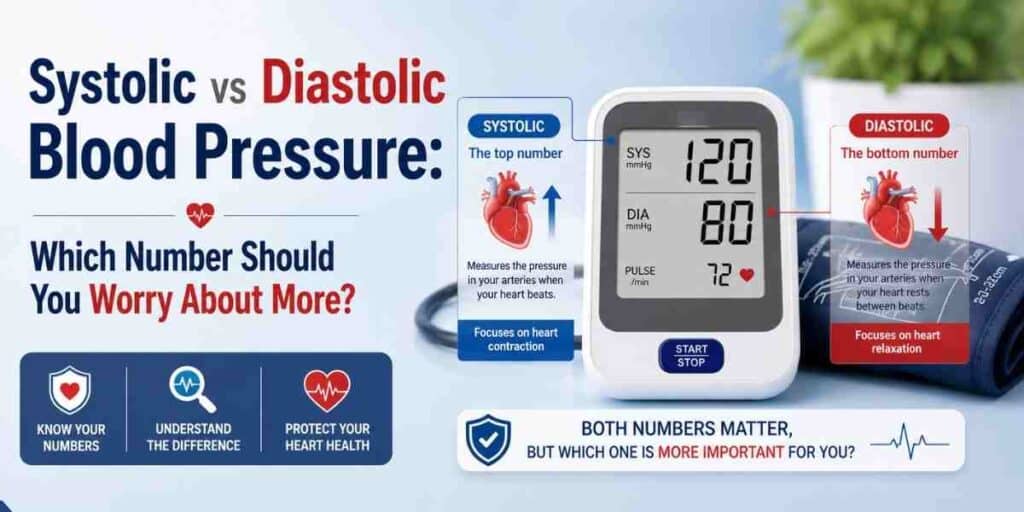
Every blood pressure reading gives you two numbers. Most people know the first one is “the top number” and the second is “the bottom number.” But beyond that? Confusion. Is the top number the important one? What if only the bottom number is high? And why do doctors seem to care about one more than the other depending on your age?
If you’ve ever stared at a reading like 138/72 and wondered whether that first number is a problem when the second one looks fine — or seen 118/94 and assumed everything was okay because the top number was normal — this guide is for you. The difference between systolic and diastolic pressure isn’t just medical trivia. It changes what risks you face, what treatment you need, and which number your GP is actually watching most closely.
Systolic (top number) = pressure when your heart beats. Diastolic (bottom number) = pressure when your heart rests. Both matter, but systolic becomes increasingly important after age 50 — elevated systolic pressure is the strongest predictor of heart attack and stroke in older adults. In younger adults (under 40), an elevated diastolic reading may be the earlier warning sign. If either number is high, your blood pressure is considered elevated — you don’t need both to be high for there to be a problem.
📖 In This Guide
- What Is Systolic Blood Pressure?
- What Is Diastolic Blood Pressure?
- Systolic vs Diastolic: Side-by-Side Comparison
- Which Number Matters More? (The Answer Changes With Age)
- Isolated Systolic Hypertension: When Only the Top Number Is High
- Isolated Diastolic Hypertension: When Only the Bottom Number Is High
- 4 Real-World Readings Explained
- The Gap Between Your Numbers Matters Too
- What to Do If Either Number Is High
- Frequently Asked Questions
1. What Is Systolic Blood Pressure? (The Top Number)
Systolic blood pressure is the peak pressure inside your arteries at the exact moment your heart contracts and pushes blood out into your body. Think of it as the maximum force wave that travels through your blood vessels every time your heart beats.
The word “systolic” comes from the Greek systole, meaning “contraction.” When your heart muscle squeezes — roughly 60 to 100 times per minute — it ejects blood into the aorta (the body’s largest artery), which then distributes it to every organ and tissue. The pressure measured at that peak moment of ejection is your systolic reading.
In a healthy adult, systolic blood pressure typically sits between 90 and 120 mmHg. When it consistently reads 140 mmHg or above in a clinical setting (or 135 mmHg at home), the NHS considers it elevated enough to investigate further.
As you get older, your large arteries — particularly the aorta — gradually lose their elasticity and become stiffer. A young, flexible aorta acts like a shock absorber, stretching to cushion each heartbeat. A stiff aorta can’t absorb that force as well, so the peak pressure (systolic) climbs higher. This is why isolated systolic hypertension is overwhelmingly a condition of older adults.
2. What Is Diastolic Blood Pressure? (The Bottom Number)
Diastolic blood pressure is the lowest pressure in your arteries, measured during the brief pause between heartbeats when your heart is relaxing and refilling with blood. It represents the baseline resistance your arteries maintain even when the heart isn’t actively pumping.
The word “diastolic” comes from the Greek diastole, meaning “expansion” or “dilation” — referring to the heart chambers expanding as they fill. During this resting phase, the elastic walls of your arteries gently recoil inward, maintaining enough pressure to keep blood flowing forward rather than pooling.
A healthy diastolic reading typically falls between 60 and 80 mmHg. A diastolic reading consistently at or above 90 mmHg is considered elevated by NHS standards.
After around age 55–60, diastolic blood pressure often begins to fall even as systolic pressure rises. This creates a widening gap between the two numbers. Many people see a falling diastolic number and assume their blood pressure is improving — when in reality, the widening gap itself may indicate arterial stiffness and increased cardiovascular risk. Never interpret one number without considering the other.
3. Systolic vs Diastolic: Side-by-Side Comparison
4. Which Number Matters More? (The Answer Changes With Your Age)
This is the question everyone asks — and for decades, even doctors debated it. The most accurate answer is: both matter, but their relative importance shifts as you age.
Under 40: Diastolic May Be the Earlier Warning Sign
In younger adults, arteries are typically still flexible, so systolic pressure rarely climbs dramatically. When blood pressure begins to creep up in this age group, it’s often the diastolic number that rises first. A 32-year-old with a reading of 122/92 — systolic looks normal, but diastolic is clearly elevated — is showing early signs of increased vascular resistance that shouldn’t be ignored.
Research published in the Journal of the American College of Cardiology has shown that elevated diastolic pressure in younger adults is independently associated with increased risk of cardiovascular events later in life.
Over 50: Systolic Becomes the Dominant Risk Factor
After age 50, systolic blood pressure becomes the strongest single predictor of heart attack, stroke, and heart failure. The landmark Framingham Heart Study — one of the longest-running cardiovascular studies in history — demonstrated that systolic pressure is a far more reliable indicator of cardiovascular risk in older adults than diastolic pressure.
This is also the age when isolated systolic hypertension becomes common — a pattern where systolic climbs above 140 while diastolic stays below 90 or even drops. Many older patients assume everything is fine because their bottom number looks “low,” but the elevated top number alone carries significant risk.
If either number is elevated — not both — your blood pressure is still considered high. A reading of 152/78 means your systolic is clearly in Stage 1 Hypertension territory, even though your diastolic is perfectly normal. A reading of 118/96 means your diastolic is elevated, even though your systolic looks ideal. You don’t need both numbers to be high for there to be a problem.
5. Isolated Systolic Hypertension: When Only the Top Number Is High
Isolated Systolic Hypertension (ISH) is defined as a systolic reading of 140 mmHg or above with a diastolic reading below 90 mmHg. It is the most common form of hypertension in adults over 65 — affecting up to 80% of hypertensive patients in this age group, according to the British Heart Foundation.
Why it happens: As arteries age and stiffen, they lose their ability to stretch and absorb the force of each heartbeat. Systolic pressure climbs because the arteries can’t cushion the pressure wave. Diastolic pressure stays the same or even falls because the stiff arteries recoil poorly between beats.
Why it’s dangerous: ISH is strongly associated with increased risk of stroke, heart failure, and kidney disease. For years, many doctors dismissed mildly elevated systolic readings in older patients as “normal for their age.” Current NICE guidelines make clear that ISH requires treatment just as much as any other form of hypertension.
Treatment: Lifestyle changes (reducing salt, exercise, weight management) combined with medication when needed. NICE guidelines typically recommend starting with a calcium channel blocker (e.g. Amlodipine) for patients over 55 with ISH.
6. Isolated Diastolic Hypertension: When Only the Bottom Number Is High
Isolated Diastolic Hypertension (IDH) is defined as a diastolic reading of 90 mmHg or above with a systolic reading below 140 mmHg. It is less common than ISH and is seen more frequently in younger adults, particularly men aged 30–50.
Why it happens: IDH is typically driven by increased peripheral vascular resistance — meaning the smaller blood vessels throughout your body are constricted or narrowed. This can result from obesity, excessive alcohol consumption, a high-salt diet, chronic stress, or a sedentary lifestyle.
Is it dangerous? The cardiovascular risk of IDH is debated among researchers. Some studies suggest it carries a lower immediate risk than elevated systolic pressure, while others argue it is an early marker that often progresses to combined systolic-diastolic hypertension if left unaddressed. The NHS treats it the same way — a persistent diastolic reading above 90 mmHg warrants investigation and follow-up.
Treatment: Lifestyle changes are the first-line approach. Because IDH is common in younger, otherwise healthy adults, GPs often recommend a trial of diet, exercise, weight loss, and stress management before considering medication.
If you’re under 40 and your doctor says your diastolic is “a bit high” but your systolic is fine — take it seriously. IDH in younger adults is often a correctable, early-stage problem. Addressing it now through lifestyle changes can prevent it from progressing to full-blown hypertension in your 50s and 60s.
7. 4 Real-World Readings Explained: What Each Pattern Actually Means
📈 Check Both Your Numbers Right Now
Enter your readings into our free calculator to see where both your systolic and diastolic fall on the chart.
8. The Gap Between Your Two Numbers Matters Too
Beyond looking at systolic and diastolic individually, there is a third metric worth knowing about: pulse pressure — the numerical difference between your two numbers. A healthy pulse pressure is around 40–60 mmHg. A consistently wide gap (above 60 mmHg) can be an independent warning sign of arterial stiffness and cardiovascular risk, even when your individual numbers don’t look alarming on their own.
We’ve written a complete, detailed guide on this topic — including how to calculate it, what’s normal, and what wide or narrow pulse pressure means for your health.
Related: Pulse Pressure Explained — What the Gap Between Your Numbers Really Means
Full guide including wide vs narrow pulse pressure, cardiovascular risk, and when to act.
Related: Mean Arterial Pressure (MAP) Explained
The single number that combines systolic and diastolic into one weighted average.
9. What to Do If Either Number Is High
- If one or both numbers are elevated in a single reading: Don’t panic. Sit quietly for 5 minutes and retake the reading. Stress, caffeine, exercise, and even talking can temporarily spike your numbers.
- If readings are consistently elevated over several days: Book a GP appointment. Under NICE guidelines, your GP will typically arrange home or ambulatory blood pressure monitoring (ABPM) over 4–7 days before making a diagnosis.
- If your reading is 180/110 or above with symptoms: This is a hypertensive emergency. Call 999.
- Start tracking: Use a validated home monitor and log your readings. Averaging multiple readings over days gives you — and your GP — a far more accurate picture than any single reading.
Related: How to Work Out Your Average Blood Pressure
Why a single reading isn’t enough, and how to calculate the number that really matters.
10. Frequently Asked Questions
What is the difference between systolic and diastolic blood pressure?
Systolic (the top number) measures the peak pressure when your heart beats and pushes blood out. Diastolic (the bottom number) measures the lowest pressure between beats when your heart is resting. Together they give a complete picture of your cardiovascular pressure cycle.
Is systolic or diastolic more important?
Both matter. In adults over 50, systolic blood pressure is the stronger predictor of cardiovascular events like heart attack and stroke. In younger adults under 40, elevated diastolic pressure may be an earlier warning sign. If either number is elevated, your blood pressure is considered high.
What is isolated systolic hypertension?
Isolated systolic hypertension is when the systolic (top) number is 140 mmHg or above while the diastolic (bottom) number remains below 90 mmHg. It is the most common form of hypertension in adults over 65 and is caused by age-related arterial stiffness.
What does it mean if only my diastolic is high?
This is called isolated diastolic hypertension. It is more common in younger adults (typically aged 30–50) and is usually driven by increased resistance in smaller blood vessels. It often responds well to lifestyle changes like reducing salt, exercising, and losing weight.
Why does systolic blood pressure increase with age?
As you age, your large arteries — especially the aorta — become stiffer and less elastic. They can no longer stretch to absorb the force of each heartbeat as effectively, so the peak pressure (systolic) climbs higher with each beat.
Can systolic be high and diastolic be low at the same time?
Yes — this is called a wide pulse pressure and is common in older adults. A reading like 160/60 shows high systolic with low diastolic, creating a large gap. This pattern typically reflects arterial stiffness and carries independent cardiovascular risk. Read our Pulse Pressure guide for a full explanation.
What is a dangerous diastolic reading?
A diastolic reading consistently above 90 mmHg is considered elevated. A reading of 110 mmHg or above — especially alongside symptoms like chest pain, severe headache, or confusion — is a medical emergency. Call 999 immediately.
One Response