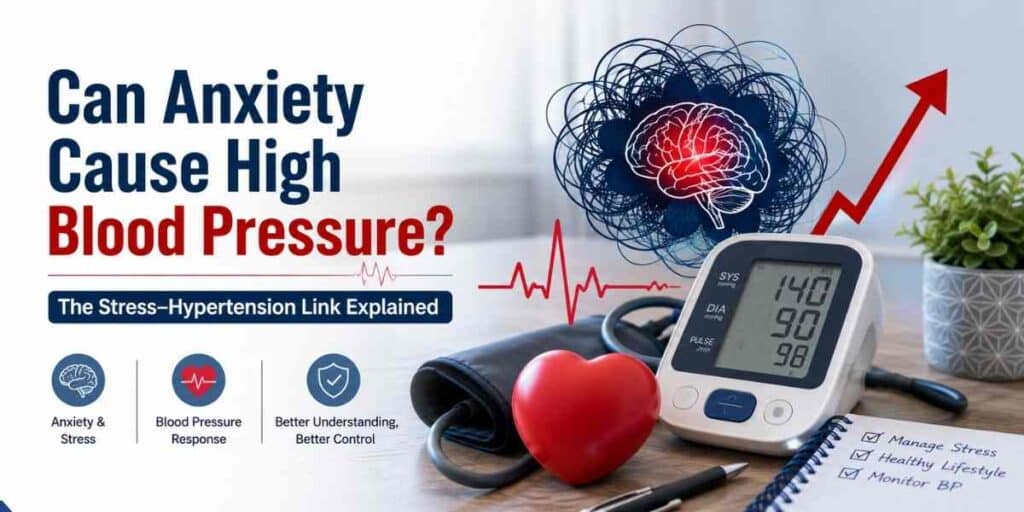
Your heart is pounding. Your chest feels tight. You check your blood pressure and the number staring back at you is terrifyingly high. Is this a real hypertension crisis — or is it just anxiety playing tricks on your body?
This is one of the most common — and most confusing — health worries people face. The truth is more nuanced than a simple yes or no. Anxiety absolutely can send your blood pressure soaring in the moment, but whether it causes lasting hypertension is a different question entirely. This guide breaks down exactly what happens in your body during anxiety, what the research really shows, and how to tell the difference between a harmless spike and something that needs medical attention.
Yes — anxiety can cause temporary spikes in blood pressure, sometimes by 20-30 points or more, due to the release of stress hormones like adrenaline and cortisol. These spikes usually settle once the anxious episode passes. However, chronic, ongoing anxiety may contribute to sustained high blood pressure over time — not necessarily by damaging your arteries directly, but through repeated stress on your cardiovascular system and anxiety-related habits like poor sleep, smoking, or alcohol use. A single anxious moment is not the same as a hypertension diagnosis.
📖 In This Guide
- What Actually Happens in Your Body During Anxiety
- Temporary Spike vs Chronic Hypertension: Why the Difference Matters
- White Coat Hypertension: When Anxiety Fools Your GP
- Masked Hypertension: The Opposite (and More Dangerous) Problem
- Can a Panic Attack Cause Dangerously High Blood Pressure?
- Does Chronic Anxiety Really Cause Long-Term Hypertension?
- 5 Warning Signs You Should Never Ignore
- How to Calm an Anxiety-Related BP Spike Right Now
- Long-Term Strategies to Break the Stress-BP Cycle
- When to See Your GP
- Frequently Asked Questions
1. What Actually Happens in Your Body During Anxiety
When your brain perceives a threat — whether it’s a genuine danger or just a stressful email — it activates what’s known as the fight-or-flight response. This is an ancient survival mechanism, and it doesn’t distinguish between a physical threat and a modern-day worry like a looming deadline or a health scare.
Here is what unfolds in seconds:
- Adrenaline floods your bloodstream — your heart rate increases immediately to pump more blood to your muscles
- Blood vessels constrict — particularly in non-essential areas like your digestive system, redirecting blood to your muscles and vital organs
- Cortisol is released — this stress hormone causes your kidneys to retain more sodium and water, increasing your total blood volume
- Breathing becomes faster and shallower — this can further increase the sensation of pressure and tightness in your chest
The combined effect of a faster heart rate, narrowed blood vessels, and increased blood volume can push your systolic blood pressure up by 20 to 30 points or more during an acute anxiety episode — sometimes even higher during a full panic attack.
This response is not a malfunction — it’s your body working exactly as designed. The problem isn’t that your body reacts to stress; the problem is when that reaction happens too often, or lasts too long, without a chance to fully recover.
2. Temporary Spike vs Chronic Hypertension: Why the Difference Matters
This is the single most important distinction to understand — and the one most people get wrong.
A single anxious moment causing a high reading does not mean you have hypertension. This is precisely why doctors and the NICE guidelines recommend confirming any high clinic reading with home or ambulatory monitoring before diagnosing hypertension.
3. White Coat Hypertension: When Anxiety Fools Your GP
White coat hypertension is a well-documented phenomenon where a person’s blood pressure reads high specifically in a medical setting — at the GP surgery or hospital — but returns to normal everywhere else. It is named after the anxiety triggered by the sight of a clinician’s white coat.
Research suggests this affects 15–30% of people who receive a high blood pressure reading at the doctor’s office. The cause is straightforward: anxiety about the appointment — fear of a new diagnosis, worry about bad news, or simple unfamiliarity with the environment — triggers the same fight-or-flight response described above.
For years, white coat hypertension was considered harmless — a quirk rather than a genuine health concern. However, more recent research now suggests it may still carry some increased cardiovascular risk compared to people with consistently normal readings, even though that risk is smaller than true sustained hypertension.
Some GP surgeries in the UK now routinely offer ambulatory blood pressure monitoring (ABPM) or ask patients to complete a course of home readings before confirming a hypertension diagnosis — precisely because of how common white coat hypertension is.
4. Masked Hypertension: The Opposite (and More Dangerous) Problem
Less well-known but arguably more concerning is masked hypertension — the exact opposite of white coat hypertension. Here, blood pressure reads normal at the GP surgery (where the patient may actually feel relaxed, away from daily stressors like traffic and work) but is consistently high in everyday life.
This is dangerous precisely because it can leave genuine hypertension undetected and untreated for years, quietly increasing the risk of heart disease, heart attack, and stroke — all while clinic readings appear perfectly normal.
If your day-to-day life involves significant stress — a demanding job, financial worry, caregiving responsibilities — but your GP readings are always normal, it may be worth asking about home blood pressure monitoring to rule out masked hypertension.
5. Can a Panic Attack Cause Dangerously High Blood Pressure?
During a panic attack, the body’s stress response is amplified to its most intense level. Breathing becomes rapid and shallow, muscles tense throughout the body, and adrenaline surges dramatically — pushing blood pressure to levels that can feel alarming, sometimes into hypertensive territory (140/90 mmHg or above) for a short period.
For most people without underlying heart or blood vessel disease, this spike — however frightening it feels — is not, on its own, dangerous. Blood vessels and the heart are generally able to withstand short bursts of elevated pressure. The reading will typically fall back to baseline within 20–30 minutes as the panic attack subsides.
However, this is different if you already have existing cardiovascular disease, uncontrolled hypertension, or other risk factors — in these cases, a severe spike carries more genuine risk, and any chest pain, severe headache, or visual disturbance during a panic attack should be treated seriously.
6. Does Chronic Anxiety Really Cause Long-Term Hypertension?
This is where the science gets genuinely complex — and where most articles oversimplify the answer. Here is an honest breakdown of what the research actually shows:
The Direct Pathway
Research has found that trait anxiety — a person’s general tendency toward anxiety — is independently associated with higher resting blood pressure, even in healthy adults without any diagnosed cardiometabolic conditions. Repeated activation of the sympathetic nervous system (the fight-or-flight system) over months and years may contribute to sustained changes in how blood vessels regulate pressure.
The Indirect Pathway (Often More Significant)
Perhaps more importantly, chronic anxiety often drives behaviours that independently raise blood pressure over time:
- Poor sleep — anxiety frequently disrupts sleep quality, and poor sleep is independently linked to higher blood pressure
- Increased alcohol use — often used to self-soothe anxiety, but alcohol raises blood pressure
- Smoking — commonly used as a stress-coping mechanism, directly damages blood vessels
- Reduced physical activity — anxiety can make exercise feel overwhelming, removing a key protective factor
- Comfort eating — often high in salt and processed foods, both linked to elevated blood pressure
The honest scientific consensus, reflected by organisations including the American Heart Association, is that anxiety is associated with increased hypertension risk, but researchers are still working to fully untangle how much comes from the direct physiological pathway versus these indirect behavioural pathways.
7. 5 Warning Signs You Should Never Ignore
Most anxiety-related BP spikes are harmless. But certain symptoms mean you should stop assuming it’s “just anxiety” and seek medical help immediately.
🚨 Seek Emergency Help If You Experience:
- Severe chest pain or pressure — not just tightness, but crushing or radiating pain
- A blood pressure reading above 180/120 mmHg alongside symptoms like severe headache, vision changes, or shortness of breath — this is a hypertensive crisis
- Numbness or weakness on one side of your body, or slurred speech — possible stroke signs
- Severe shortness of breath that doesn’t improve with slow breathing
- Confusion or difficulty staying alert
These symptoms could indicate a genuine cardiac or neurological emergency rather than anxiety alone. Call 999 immediately.
8. How to Calm an Anxiety-Related BP Spike Right Now
If you’re in the middle of an anxious moment and want to bring your numbers down safely, these evidence-based techniques can help:
- Slow, deep breathing: Try inhaling for 4 seconds, holding for 4, and exhaling for 6-8 seconds. This activates your parasympathetic nervous system — your body’s natural “brake” on the stress response.
- Sit down and rest quietly for 5-10 minutes: Avoid checking your reading repeatedly, as this itself can trigger more anxiety and skew the number further.
- Progressive muscle relaxation: Deliberately tense and then release each muscle group, working from your feet up to your head.
- Grounding techniques: Name 5 things you can see, 4 you can hear, 3 you can touch — this interrupts the anxiety spiral and brings your focus back to the present.
- Step away from the trigger if possible: If a specific situation is causing the spike, removing yourself even briefly can help your body begin to settle.
These techniques help manage a temporary, anxiety-driven spike. They are not a treatment for chronic hypertension and should never replace prescribed blood pressure medication or medical advice.
📈 Track Your Readings to Spot the Pattern
Use our free calculator to average multiple readings over several days and see whether high numbers are a genuine trend or an anxiety-driven blip.
9. Long-Term Strategies to Break the Stress-BP Cycle
If anxiety is a regular part of your life, addressing it directly is one of the most effective ways to protect your long-term cardiovascular health — often more impactful than trying to manage each individual spike.
Related: 15 Best Exercises for High Blood Pressure
Practical workout ideas that also help lower stress and anxiety levels.
10. When to See Your GP
Book an appointment with your GP if:
- Your blood pressure is consistently high, even outside of anxious moments
- Anxiety is significantly affecting your daily life, sleep, or relationships
- You experience frequent panic attacks
- You’ve noticed yourself relying on alcohol, smoking, or other unhealthy coping mechanisms
- You’re unsure whether your high readings are anxiety-related or a genuine sign of hypertension
Your GP can arrange home or ambulatory blood pressure monitoring to clarify the picture, and can also discuss anxiety treatment options — including therapy referrals and, where appropriate, medication. Treating anxiety is not just good for your mental health; it’s a legitimate strategy for protecting your cardiovascular health too.
🏥 Is It Anxiety or Genuine High Blood Pressure?
Track your readings over several days to see the full picture, not just a single stressful moment.
11. Frequently Asked Questions
Can anxiety cause high blood pressure permanently?
Anxiety on its own does not typically cause permanent hypertension in the way that, for example, kidney disease or obesity might. However, chronic anxiety can contribute to sustained high blood pressure over time — both through repeated physiological stress and through anxiety-linked habits like poor sleep, smoking, or alcohol use.
How much can anxiety raise blood pressure?
Research shows that acute anxiety can raise systolic blood pressure by 20 to 30 points or more during an intense episode. A severe panic attack may push readings even higher. These spikes are usually temporary and settle within 20-30 minutes once the anxiety passes.
What is white coat hypertension?
White coat hypertension is when blood pressure reads high specifically in a medical setting, such as a GP surgery, due to anxiety about the appointment, but returns to normal in everyday life. It affects an estimated 15-30% of people with a high clinic reading.
Can panic attacks cause a hypertensive crisis?
For most people without existing cardiovascular disease, a panic attack alone is unlikely to cause a true hypertensive crisis (a reading above 180/120 mmHg with organ damage symptoms). However, if you experience severe chest pain, vision changes, or confusion alongside a very high reading, treat it as a medical emergency and call 999.
Should I take my blood pressure when I’m feeling anxious?
It’s best to measure your blood pressure when you are calm and have been sitting quietly for at least 5 minutes. If you’re feeling anxious, try to wait until you’ve settled before taking a reading, as an anxiety-driven spike won’t give you an accurate picture of your baseline blood pressure.
Does treating anxiety lower blood pressure?
For some people, yes. Effective anxiety treatment — including therapy such as CBT, lifestyle changes, and where appropriate, medication — can help reduce the frequency and intensity of stress-related blood pressure spikes, and may contribute to better overall cardiovascular health over time.
What is masked hypertension?
Masked hypertension is the opposite of white coat hypertension — blood pressure appears normal at the GP surgery but is consistently high in everyday life. It can leave genuine hypertension undetected, so if you have significant daily stress but normal clinic readings, home monitoring may be worth discussing with your GP.