Introduction
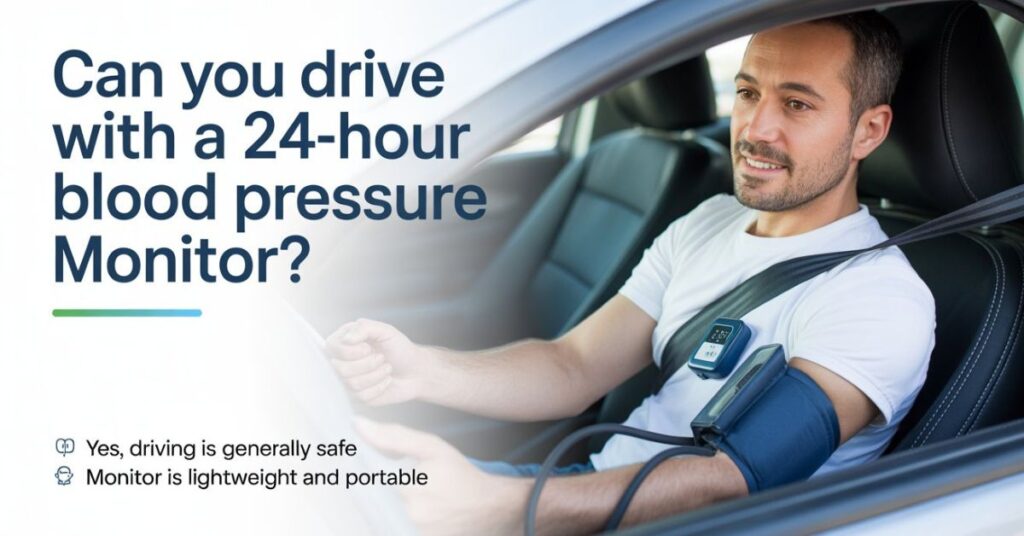
Picture this: you’ve just been fitted with a 24-hour blood pressure monitor by your doctor to check how your blood pressure behaves over a day and night. It’s strapped to your arm, connected by a little tube to a monitor on your belt. Suddenly you realise you have errands to run, or that you might need to drive home. So you ask: “Can you drive with a 24-hour blood pressure monitor?”
This question isn’t just academic. Driving demands your full attention, safe control of the steering wheel, and the ability to react quickly. If the monitor inflates the cuff unexpectedly, or the arm is restricted, or you’re distracted, there could be safety implications. In this article we’ll walk through what a 24-hour blood pressure monitor is, what driving while wearing one really involves, when it’s safe (or not), and practical tips to stay safe while you’re being monitored.
Whether you’re based in the UK or the USA, this friendly, clear guide explains all you need to know, even if you aren’t familiar with medical jargon. We’ll also link you to useful tools like the [blood pressure average calculator] and healthy lifestyle guides like Food Groups for a Healthy Diet: Your Complete Guide to Balanced Nutrition and 8 Tips to Healthy Eating: Your Simple Guide to a Balanced Diet.
So let’s get into it.
What is a 24-Hour Blood Pressure Monitor?
Definition and how it works
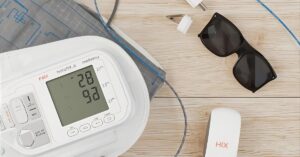
A “24-hour blood pressure monitor” (often called ambulatory blood pressure monitoring or ABPM) is a device you wear for roughly a full day (24 hours) that takes repeated blood pressure readings while you go about your usual activities (and sleep). Smartcare Diagnostics+3Wikipedia+3mrclinic.com.au+3
Typically, you’ll have:
-
A cuff wrapped around your upper arm. London Heart Clinic+1
-
A small monitor (often worn on a belt or shoulder strap) that connects to the cuff by a tube. mrclinic.com.au+1
-
The cuff inflates/deflates at regular intervals (say every 15-30 minutes during the day, maybe hourly at night), collecting many readings so your doctor can see how your blood pressure changes over the whole day. mrclinic.com.au+1
Why it’s used
Doctors use a 24-hour monitor for reasons such as:
-
Checking whether you really have high blood pressure (hypertension) outside the clinic. This helps rule out “white-coat hypertension” (when blood pressure is high only in a medical setting). London Heart Clinic+1
-
Seeing how your blood pressure behaves overnight or during your normal routine, which a single clinic reading might miss.
-
Assessing how effective your blood-pressure treatment is over 24 hours.
So in short: it’s a safe, non-invasive way to get a fuller picture of your blood pressure beyond the office.
The Core Question: Can You Drive While Wearing One?

What different clinics say
Here are some real-world statements from clinics:
-
One UK clinic states: “You are allowed to drive with the blood pressure monitor in place, but it can affect your driving abilities. We advise that you refrain from driving if possible.” pah.nhs.uk
-
Another UK heart testing centre states: “It is not advisable to drive during the 24 hours you are wearing the monitor. For this reason, you should arrange transport to and from your appointment.” London Heart Clinic
-
A medical site in Australia notes: “There may be times, such as when driving a vehicle, that the monitor commences a measurement… At a time like this, it would not be safe to remove your hand from the steering wheel and dangle your arm down by your side. Don’t be concerned about missing the occasional measurement for this reason.” Dr Young Yu · Cardiologist · Sydney
-
Other sources say the device “does not impair your ability to drive” but emphasise that you should keep your arm relaxed and avoid interfering with the measurement. Smartcare Diagnostics
Key considerations (safety, comfort, accuracy)
From these statements you can deduce that although you can drive in many cases, there are important caveats. The main issues:
-
Distraction / safety: When the cuff inflates, your arm tightens, you may feel discomfort, and your attention may be drawn away from driving.
-
Arm movement & measurement accuracy: The device often instructs you to keep the arm still and hanging freely when the measurement occurs. While driving, your arm may be on the steering wheel, moving, or tensed–which can interfere with recordings. hurstvilleheart.com.au
-
Comfort / interference: The monitor strap, belt, and tubing might become uncomfortable or interfere with normal driving posture.
-
Legal/insurance implications: If you drive and have a safety-critical incident while wearing a monitor, there may be questions about whether you were fit to drive. The fact that some clinics say “not advisable to drive” suggests a grey area.
So the short answer to the question “can you drive with a 24-hour blood pressure monitor?” is: Yes, in some cases, but you need to assess whether it’s safe for you and ideally avoid driving if you can arrange transport.
Factors That Affect Whether Driving Is Safe

The cuff inflation cycles and how they may interfere
-
The cuff will inflate regularly: e.g., every 30 minutes during the day and maybe hourly at night. mrclinic.com.au+1
-
When inflation happens, your upper arm becomes tight and movement can be more difficult or uncomfortable.
-
If a measurement occurs while you’re driving, you might be forced to relax your arm, stop steering properly, or release your grip — which can be unsafe. The Australian site explicitly warns you may need to miss a reading rather than jeopardise safe driving. hurstvilleheart.com.au
-
If the monitor fails the reading (due to arm movement) it will retry, meaning multiple inflations and potential distraction.
Arm movement, distraction, comfort
-
If your arm is on the steering wheel, you may not be able to let it hang freely (the recommended posture for accurate reading) without compromising steering.
-
You may be distracted by the monitor’s noise or the feeling of tightening.
-
The strap or belt may affect your overall comfort, especially over a longer journey (which increases fatigue).
-
If you start to feel light-headed, uncomfortable or have a reading that bothers you, you might feel anxious, which itself could affect driving.
Legal / regulatory aspects (UK, USA)
-
In the UK, the licensing authority (Driver and Vehicle Licensing Agency – DVLA) requires drivers to be in a fit physical and mental state. Wearing a monitor isn’t a disqualification in itself, but if the monitor affects your ability to drive safely you could breach that requirement.
-
In the USA, individual state laws require drivers to be physically and mentally capable of safe driving. If you feel impaired, you should avoid driving.
-
Insurance companies: If you have an incident and it emerges that you were wearing a monitor and had breached medical advice (e.g., ‘not advisable to drive’), there could be complications with insurance claims.
-
Many clinics in the UK simply say “arrange transport” or “refrain from driving if possible”. That suggests the safest approach is to arrange alternative transport.
Real-Life Examples and Scenarios

Example 1: Fitting appointment, driving immediately afterwards
John, aged 52, has been referred for a 24-hour blood pressure monitor. He arranges with his clinic to be fitted mid-afternoon. The clinic advises that when the monitor is placed, he should not drive home but rather take someone with him or use a taxi. He arranges a lift. He wears the device overnight, returns it the next afternoon. In this case, John did not drive while wearing it, based on clinic advice.
Take-away: If the clinic explicitly says “not advisable to drive”, you should plan other transport.
Example 2: Wearing the monitor during normal daily routine including driving
Sarah, aged 38, is asked to wear the monitor starting in the morning. She needs to commute by car (about 30 minutes). Her clinic states you can drive but “it can affect your abilities”. She drives to work, keeping her driving short, avoids any heavy traffic, ensures the cuff is on her non-dominant arm and maintains relaxed posture. She avoids longer journeys, stays alert, and records if she skips any readings due to driving.
Take-away: Driving may be possible if the journey is short, traffic light, and you’re comfortable — but you must assess risk.
Example 3: When driving should definitely be avoided
Mark, 65, has just been fitted with a monitor and also has some dizziness when his cuff inflates. His clinic told him driving was “not advisable”. He has an early morning appointment at 07:00 and the cuff begins inflating around 07:15 (while still at home). He then plans a 45-minute motorway drive. He decides to ask his wife to drive.
Take-away: If you have additional health vulnerability (dizziness, leg weak, high stress traffic), the safe choice is not to drive.
Practical Tips if You Must Drive While Wearing One
Here are some friendly, practical tips to help you stay safe if you need to drive while wearing a 24-hour blood pressure monitor.
Before the fitting
-
Wear a loose-fitting top or shirt so the cuff fits easily and is comfortable. Many clinics advise that. pah.nhs.uk+1
-
Choose the non-dominant arm for the monitor if possible (less interference while steering).
-
Ask the clinic explicitly: “Is it OK for me to drive during the monitoring period?” Make a note of their recommendation (some may say yes with caution, others say no).
-
If you plan to drive, schedule the fitting so you can go straight home or to a low-traffic route afterwards rather than a busy commute.
-
Ensure you’re well rested, not fatigued, avoid heavy traffic if possible.
During the monitoring period / while driving
-
Ensure your arm with the cuff is comfortable and not overly restricted: perhaps rest it lightly, not gripping too tensed.
-
If you feel the cuff starting to inflate and you are driving, you must keep your safety first. If the inflation is about to interfere with your steering, you might need to stop safely (pull over) rather than risk losing control. The Australian clinic explicitly says: if you’re driving and the cuff inflates, you may miss the reading rather than endanger safety. Dr Young Yu · Cardiologist · Sydney
-
Try to plan your journey when traffic is light, so you’re less stressed and more in control.
-
Avoid long journeys, heavy traffic or complex driving (motorways, fast lanes) if possible while wearing the device.
-
Keep a diary or notes of when the cuff inflates, if you skip readings due to driving, and any symptoms (dizziness, discomfort) — the clinic may ask for this. Some clinics ask you to note the time and reason for reading/skip. gloshospitals.nhs.uk
-
If you feel any dizziness, light-headedness or discomfort, stop driving, remove yourself safely from the road and consider calling for help / alternative transport.
After the monitoring period
-
Return the device on time as per your clinic instructions.
-
Review your results with your doctor.
-
Reflect on whether driving while wearing the device felt comfortable or safe for you — next time you might avoid driving altogether if you found it distracting.
When Driving Should Definitely Be Avoided

There are instances where driving while wearing a 24-hour blood pressure monitor is not recommended and you should arrange alternative transport:
-
Your clinic has explicitly told you: “not advisable to drive” while wearing the monitor. (Many do) London Heart Clinic
-
You experience symptoms such as dizziness, fainting, blurred vision, or weakness — especially relevant for people with blood pressure problems.
-
The monitor cuff inflation frequently distracts or interferes with your driving — e.g., you find your arm tensing or steering becoming awkward.
-
You’re about to undertake a long, complex, high-traffic journey (e.g., motorway, rush hour) while wearing the monitor — this adds risk.
-
You’re in a profession where driving safely is critical (e.g., commercial driving, public transport) — the slightest distraction could have serious consequences.
-
Your insurance or licensing authority has specific guidance or restrictions (check your policy / licence conditions).
-
You are being monitored because you had significant blood pressure issues and the monitoring period coincides with a time you might need to drive long distances or under stress — better to postpone.
Linking with Other Health Topics
Wearing a 24-hour blood pressure monitor is one part of a broader health-care picture. It links with other important topics:
-
If you want to make sense of your results (once you have them), you might use a blood pressure average calculator to interpret the numbers (mean arterial pressure, day vs night averages) — see our internal link to the blood pressure average calculator.
-
It’s a good time to reflect on your diet and lifestyle: good blood pressure control goes hand in hand with what you eat. Check out Food Groups for a Healthy Diet: Your Complete Guide to Balanced Nutrition and 8 Tips to Healthy Eating: Your Simple Guide to a Balanced Diet for helpful guidance.
-
If driving is part of your routine, think about how long journeys, stress and diet might affect your blood pressure — perhaps rounding off your commute with a short walk, or avoiding heavy traffic when possible.
Conclusion
So, to answer the question: “can you drive with a 24-hour blood pressure monitor?” — yes, in many cases you can, but you must proceed with caution. The monitor itself doesn’t necessarily forbid driving, but it can affect your driving safety and comfort. Several clinics advise that driving is not advisable or should only happen if you’re confident you can maintain control without being distracted by cuff inflations, arm movement or discomfort.
Here are your key take-away points:
-
Ask your clinic specifically whether driving is fine in your case — their advice may differ depending on your health situation.
-
If you do drive: aim for short, easy journeys, minimise stress, keep your arm comfortable, and be prepared to stop if needed.
-
If you feel any symptoms — dizziness, discomfort — or anticipate a long or stressful drive, arrange alternative transport.
-
After the monitoring period, review your results and reflect on how wearing the monitor affected your driving — and whether next time you’d prefer not to drive at all.
Remember: your safety (and that of others on the road) comes first. The monitor is there to help understand your blood pressure better — it should not compromise your ability to drive safely.
If you found this helpful, please comment below with your own experience of wearing a 24-hour blood pressure monitor (and whether you drove or not). And if you know someone about to wear one and wondering about driving, feel free to share this article.
Drive safely — and stay well.
Call-to-Action:
Are you wearing a 24-hour blood pressure monitor now or about to? Leave a comment below with your questions or experience — we’d love to hear how it went for you. And if you found this article useful, share it with friends or family who might also wonder whether they can drive while wearing theirs.