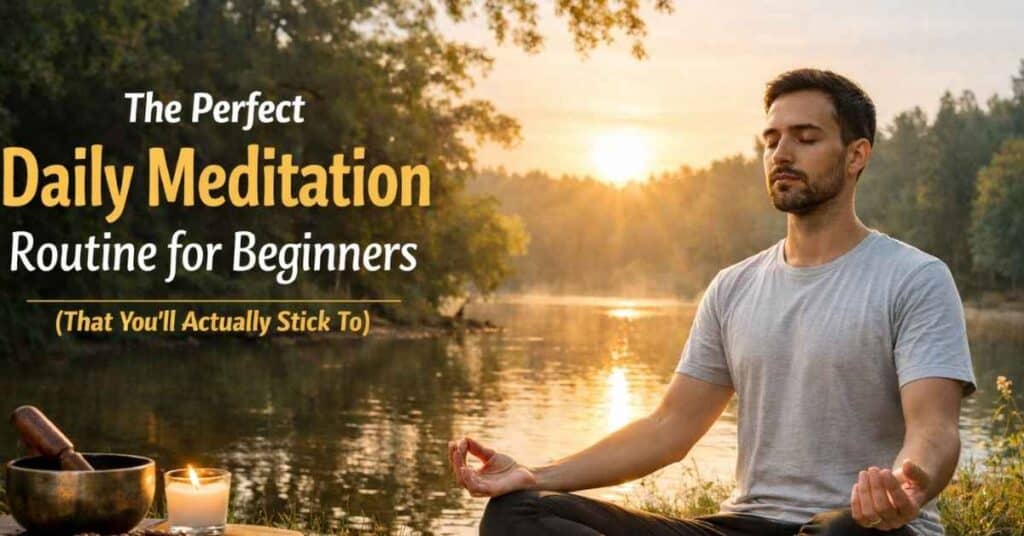
If you have ever found yourself lying in bed at night with your mind racing about tomorrow’s to-do list, or felt your shoulders tense up during your morning commute, you aren’t alone. Life in the UK moves fast. Between juggling work deadlines, family commitments, and trying to maintain some semblance of a social life, it is easy to feel like you are running on empty.
You have probably heard that meditation can help. Maybe you’ve even tried it. Perhaps you sat down on a cushion, closed your eyes… and immediately thought about what you were having for dinner.
Here is the good news: You don’t need to be a monk in the mountains to reap the benefits. You just need a Daily Meditation Routine for Beginners that actually fits your lifestyle. This guide isn’t about achieving complete silence in your mind; it’s about learning to be comfortable with the noise.
By the end of this article, you will have a step-by-step blueprint to start meditating today—no fancy equipment required.
Why Bother with a Daily Meditation Routine?
Before we get into the “how,” let’s look at the “why.” In a world obsessed with productivity, meditation is often misunderstood as “doing nothing.” In reality, it is mental hygiene.
Think of your mind like a computer. Throughout the day, you open dozens of tabs—worries, plans, memories. A Daily Meditation Routine for Beginners is simply the act of closing the tabs that aren’t in use. This reduces stress, improves focus, and helps regulate emotions.
Interestingly, research has shown a strong link between mental well-being and physical health. For example, chronic stress is a major contributor to hypertension. If you are concerned about your health markers, you might find our detailed Your Essential Guide to the High Blood Pressure Chart for Women helpful, as meditation is often recommended as a complementary practice to support healthy readings.
The Myth of the “Blank Mind”
One of the biggest barriers for beginners is the misconception that meditation means stopping your thoughts. Let’s clear that up right now.
You will never stop your thoughts.
Even experienced meditators have thoughts. The goal is not to turn off the tap; it’s to stop letting the water flood the kitchen. In your Daily Meditation Routine for Beginners, the goal is simply to notice when you have drifted off and gently bring your attention back.
Setting Up for Success: Your Environment
You don’t need a dedicated “zen den” to start. You just need a few seconds of preparation.
The “Emergency Stop” Technique
Sarah, a teacher from Manchester, once told me she couldn’t meditate because her house was too noisy. We adapted her routine. Instead of fighting the noise, she used it. She now sits in her car for two minutes before entering the house after work. She isn’t trying to relax; she is simply transitioning from “Teacher Mode” to “Mum Mode.”
Your Task: Find your “emergency stop.” It could be the corner of your sofa, a park bench during lunch, or even the bathroom at work. Consistency of location helps trigger your brain into “meditation mode.”
Your 7-Step Daily Meditation Routine for Beginners
Let’s break this down into digestible steps. We are aiming for 5 minutes to start. Anyone can do five minutes.
1. The 60-Second Body Scan
Do not close your eyes immediately. Start with your eyes open.
-
Place your feet flat on the floor.
-
Feel your back against the chair.
-
Notice the weight of your hands on your thighs.
-
Why? This anchors you in the present. Anxiety lives in the future (“What if?”) and depression lives in the past (“If only”). This brings you to the “now.”
2. Anchor Your Breath
Once you feel grounded, gently close your eyes.
Bring your attention to your breath. Don’t change it. Just follow it.
Notice the cool air entering your nose and the warmer air leaving.
Real-Life Example: Think of your mind like a puppy. If you are trying to train a puppy to sit, you don’t shout at it when it wanders off. You gently bring it back. Do the same with your attention.
3. The “Noting” Technique
This is a game-changer for a Daily Meditation Routine for Beginners.
When a thought pops up (and it will), don’t push it away. Simply label it silently:
-
“Ah, that’s planning.”
-
“Ah, that’s worrying.”
-
“Ah, that’s remembering.”
By labelling the thought, you activate the logical part of your brain and disengage from the emotional reaction.
4. Introduce a Mantra (Optional)
If following your breath feels boring or stressful, try a mantra. This is a word or phrase repeated silently.
-
Traditional: “Om” or “Peace.”
-
Practical (UK Edition): “In” (breathing in calm), “Out” (breathing out tension).
5. Dealing with Physical Discomfort
If your foot falls asleep or your back itches, acknowledge it. Usually, the itch is just a sensation.
-
The Rule: If it’s a sensation, observe it. If it’s pain (a sharp, urgent signal), adjust gently without judgement.
6. The “Gratitude Sandwich”
In the last minute of your practice, shift your focus.
Think of one small thing you are grateful for. It doesn’t have to be profound. It could be:
-
The fact that the kettle boiled quickly this morning.
-
The smell of the rain on the pavement.
Ending on gratitude trains your brain to scan the world for positives rather than threats.
7. The Transition Back
Don’t jump up immediately. Wiggle your fingers. Wiggle your toes. Slowly open your eyes. Notice how the room looks slightly different—sharper, calmer.
Common Beginner Struggles (And How to Fix Them)
Even with the perfect Daily Meditation Routine for Beginners, you will hit bumps. Here is how to navigate the most common roadblocks.
“I Don’t Have 5 Minutes”
Yes, you do. Do you have 30 seconds? Try “Micro-Meditations.”
-
The Red Light Meditation: Every time you are stopped at a red light, take three deep breaths before you check your phone.
-
The Hand-Washing Meditation: While washing your hands, focus only on the sensation of the soap and the temperature of the water for 20 seconds.
“I Keep Falling Asleep”
This is a sign you are tired! If you are consistently falling asleep during meditation, your body is telling you it needs rest, not mindfulness. Either meditate sitting upright (not lying down) or simply go to bed earlier.
“My Legs Hurt When I Sit Cross-Legged”
Forget the lotus position. Meditation has nothing to do with how flexible your hamstrings are. Sit in a chair. Sitting on the edge of a dining chair is actually preferable for alertness than sinking into a soft sofa.
The Science: Why This Works on Your Brain
It isn’t magic; it’s neuroplasticity. Every time you successfully notice your mind wandering and bring it back to your breath, you are strengthening a neural pathway.
Think of it like going to the gym. You don’t go for one day and expect abs. But if you do your Daily Meditation Routine for Beginners consistently, your “attention muscle” gets stronger.
For authoritative reading on the psychological benefits of this practice, you can review the extensive research compiled by the American Psychological Association regarding mindfulness and stress reduction .
Furthermore, the NHS often recommends mindfulness-based therapies for managing recurring depression, highlighting how mainstream this practice has become in modern healthcare .
Adapting Your Routine for Different Moods
A rigid routine breaks. A flexible routine sticks. Here is how to adapt your practice based on how you feel that day:
The High-Energy Day
If you are buzzing with energy, trying to sit still might feel like torture.
-
Try: Walking Meditation. Walk slowly back and forth in your living room or garden. Focus on the lifting and placing of each foot. No music, no podcast—just the sensation of walking.
The Low-Energy/Sad Day
If you feel flat, silence can feel loud and lonely.
-
Try: Loving-Kindness Meditation. Instead of focusing on the breath, repeat phrases wishing safety and happiness to yourself and others. “May I be happy. May I be safe. May I be healthy.”
The Anxious Day
If anxiety is high, the body often feels cold or tight.
-
Try: Self-Soothing Touch. Place one hand on your heart and one on your belly. Feel the warmth of your hands. This releases oxytocin and calms the nervous system instantly.
Tracking Your Progress (Without Obsessing)
How do you know if it’s working? You won’t suddenly see a lightbulb over your head. Progress is subtle.
-
You notice sooner. You used to be angry for an hour before you realized you were angry. Now, you notice after 10 minutes.
-
Reactions become responses. Instead of snapping at a family member, you pause.
-
Boredom feels less scary. You can wait in a queue without reaching for your phone.
Connecting Mindfulness to Physical Health
As you settle into your Daily Meditation Routine for Beginners, you may become more attuned to your body’s signals. Many people report noticing physical tension they previously ignored. This heightened awareness is powerful for preventative health.
For instance, while meditation won’t directly cure hypertension, it significantly lowers cortisol levels, which contributes to arterial health. To understand how your lifestyle choices impact your numbers, be sure to read our companion piece, Your Essential Guide to the High Blood Pressure Chart for Women , which breaks down systolic and diastolic readings in plain English.
Conclusion: The Gift of One Breath
Starting a Daily Meditation Routine for Beginners is not about adding another chore to your list. It is about removing the clutter. It is the ultimate act of self-care because it tells your nervous system, “You are safe right now.”
You don’t need to commit to a lifetime today. Just commit to tomorrow morning. Sit for two minutes. Notice the breath. Label a few thoughts. Appreciate the warmth of your cup of tea afterwards.
That is it. That is the practice.
💬 Join the Conversation
Have you tried meditating before and struggled with sitting still? Or are you a seasoned pro with a tip for the newbies? We would love to hear from you!
Leave a comment below: What is the biggest distraction you face when trying to meditate?
If you found this guide helpful, please share it with a friend who needs a little calm in their life. Pin this post to your “Mindfulness UK” Pinterest board to keep it handy for your morning routine.