Have you ever felt a wave of dizziness, a sudden blur in your vision, or even a little unsteady when you stand up too quickly? For most of us, it’s a fleeting moment. We shake it off and carry on.
But what if I told you that this common sensation could be a vital clue to your cardiovascular health? As someone who has spent years in clinical practice, I’ve seen firsthand how a simple, two-part blood pressure test—measuring both lying and standing—can uncover hidden issues that a standard reading in a doctor’s chair completely misses.
This isn’t just another medical procedure. It’s a story told by your body in two different chapters: one of rest and one of action. Understanding this story is key to managing your well-being.
In this comprehensive lying and standing blood pressure measurement guide, I’ll walk you through exactly why this test is so important, how it’s done correctly (according to NICE and NHS guidelines), and what the numbers mean for you. We’ll ditch the confusing jargon and replace it with clear, practical advice you can use.
Why Measure Blood Pressure Lying and Standing? The Story of Orthostasis

Let’s start with the “why.” Your body is a marvel of engineering. When you stand up, gravity tries to pull about a pint of blood down into your legs and feet. To counter this, your nervous system quickly tells your blood vessels to tighten and your heart to beat a little faster. This ensures a steady flow of blood—and the oxygen it carries—reaches your brain.
Sometimes, this system doesn’t work as it should. The response is delayed or not strong enough. This leads to a temporary drop in blood pressure, a condition known as Orthostatic Hypotension (or postural hypotension).
Think of it like the plumbing in an old house. If the water pressure drops suddenly when you turn on a tap upstairs, you know there’s an issue with the pump or the pipes. Similarly, a significant lying and standing BP difference signals a potential issue with your body’s “pump and pipes”—your circulatory and nervous systems.
Who Needs This Test?
While not everyone needs this for a routine check, it’s particularly crucial if you experience:
-
Dizziness or lightheadedness upon standing
-
Blurry vision or feeling faint when you get out of bed
-
Unexplained falls, especially in older adults
-
Chronic fatigue
-
If you are on medications for high blood pressure, heart conditions, or Parkinson’s disease.
Ignoring these signs means missing a critical piece of your health puzzle.
The Official Guidelines: What NICE and the NHS Say

In the UK, healthcare professionals follow evidence-based guidelines to ensure consistency and quality of care. For this test, the key references are the NICE guidelines and NHS protocols.
Lying and Standing Blood Pressure NICE Guidelines
The National Institute for Health and Care Excellence (NICE) provides clear guidance. They recommend performing a lying and standing BP test for:
-
Adults with suspected orthostatic hypotension (based on symptoms).
-
Adults aged 65 and over during their initial assessment.
-
People with Parkinson’s disease at diagnosis and then annually.
The key takeaway from NICE is the threshold for a significant drop. A positive test—indicating orthostatic hypotension—is typically defined as:
-
A sustained fall in systolic blood pressure of at least 20 mmHg, or
-
A sustained fall in diastolic blood pressure of at least 10 mmHg.
-
The “sustained” part is important—it’s not a fleeting dip but one that persists for several minutes.
Lying and Standing Blood Pressure NHS Practice
Within the NHS, the guidelines are put into daily practice. The procedure is very standardized to ensure accuracy. If a nurse or GP suggests this test, they are following a rigorous protocol to get the most reliable result possible, often using it to fine-tune medication doses for conditions like hypertension.
Your Step-by-Step Lying and Standing BP Measurement Guide
Now, let’s get practical. How is this test actually performed? Whether it’s being done in a clinic or you’re learning to do it at home (with your doctor’s guidance), the steps are critical for accuracy.
Before You Begin: Preparation is Key
-
Environment: Find a quiet, comfortable room.
-
Rest: Sit quietly for at least 5 minutes before starting. Don’t talk.
-
Bladder: Empty your bladder beforehand. A full bladder can artificially raise your blood pressure.
-
Clothing: Wear a short-sleeved shirt or loose sleeves that can be rolled up easily.
-
Avoid Triggers: Don’t smoke, drink caffeine, or exercise for at least 30 minutes before the test.
The Step-by-Step Procedure
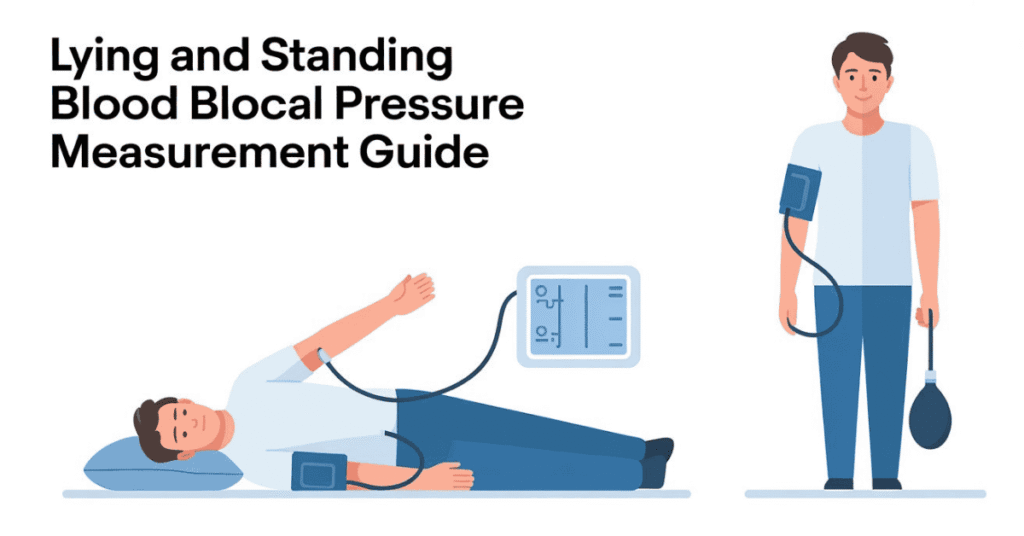
Step 1: The Lying Position Measurement
-
Lie down flat on a comfortable surface (like an exam couch or firm bed). Use a small pillow if needed.
-
Rest in this position for at least 5 minutes. This allows your body to reach a true resting state. This waiting period is a non-negotiable part of the lying and standing BP timing.
-
Position your arm so that the cuff is at the level of your heart, resting comfortably by your side.
-
Take your first blood pressure reading and note down the result. Also note your heart rate (pulse).
Step 2: The Standing Position Measurement
This is where timing and technique are everything.
-
Stand Up Smoothly: After the lying reading, stand up smoothly and without delay. Don’t use your arms to push yourself up vigorously if you can help it; try to use your core and leg muscles.
-
Immediate Reading: As soon as you are standing steadily, have your helper take the blood pressure reading. This is the “time zero” standing reading.
-
The 1-Minute and 3-Minute Readings: Continue to stand still. Take additional readings at 1 minute and 3 minutes after standing. It’s crucial to record all of these.
-
Posture: Stand still, with your feet slightly apart. Do not lock your knees. Let your arm with the cuff hang loosely at your side, or support it so the cuff remains at heart level.
A Real-Life Scenario from My Clinic: I once saw a patient, Margaret, who complained of morning dizziness. Her in-chair reading was perfectly normal. But when we did the lying and standing test, her systolic pressure plummeted by 30 points at the one-minute mark. It recovered slightly by three minutes, but the drop was clear. This single test revealed why her mornings were a struggle and allowed us to safely adjust her medication timing.
The Lying and Standing BP Chart: Interpreting Your Numbers

So, you have a set of numbers. What do they mean? This lying and standing BP chart will help you understand the patterns.
| Time Point | Normal Response | Significant Drop (Orthostatic Hypotension) |
|---|---|---|
| Lying Down | e.g., 130/80 mmHg | e.g., 140/85 mmHg |
| Immediately Standing | Systolic may rise slightly or stay stable. | A large, immediate drop may indicate a different issue. |
| 1 Minute After Standing | Systolic is stable (within 20 pts of lying). | A fall of ≥20 mmHg systolic or ≥10 mmHg diastolic. |
| 3 Minutes After Standing | Systolic and diastolic have stabilized or returned to baseline. | The low pressure persists at or beyond the 3-minute mark. |
What is a positive lying and standing BP? It’s when that significant drop we defined earlier (≥20 mmHg systolic or ≥10 mmHg diastolic) is recorded and sustained at the 1 or 3-minute mark.
It’s also worth noting the heart rate. A large rise in heart rate (e.g., more than 30 beats per minute) upon standing, especially if accompanied by symptoms, can be a sign of another condition like POTS (Postural Tachycardia Syndrome), which is why measuring pulse is a key part of this test.
Pro Tip: To truly understand your overall cardiovascular risk, it’s helpful to see how a single reading fits into the bigger picture. Use our Blood Pressure Average Calculator to make sense of your numbers over time.
Common Mistakes and How to Avoid Them

Even small errors can lead to misleading results. Here are the most common pitfalls I see.
1. Incorrect Timing
This is the biggest one. The lying and standing BP timing is precise. Not waiting the full 5 minutes lying down, or taking the standing readings too late, completely invalidates the test. Set a timer!
2. Talking During the Test
Talking or being active during the rest periods or measurements can raise your blood pressure. Stay quiet and still.
3. The Wrong Cuff Size
Using a cuff that is too small or too large is a classic error. A too-small cuff can overestimate your BP, while a too-large one can underestimate it. Measure your arm and use the correct size.
4. Poor Body Position
Letting the arm with the cuff dangle without support, so it’s below heart level, will give you a falsely high reading. Ensure the cuff is always at heart level.
5. “White Coat Syndrome”
Nervousness in a clinical setting can skew numbers. This is why home monitoring, done correctly, can be so valuable. If you’re feeling anxious, practice some deep breathing before and during the test. For more on managing this, see our guide on How to Sleep with a 24-Hour Blood Pressure Monitor: Expert Tips, Real-Life Advice.
Linking to Broader Health and Lifestyle

Managing blood pressure isn’t just about monitoring; it’s about holistic health. A positive lying and standing BP reading often prompts a review of lifestyle and other management strategies.
For instance, incorporating gentle, mindful movement can be incredibly beneficial. Certain exercises can improve circulation and vascular health without causing drastic pressure shifts. If you’re looking for a safe place to start, explore our guide to Yoga Asanas for High Blood Pressure: Your Complete Guide to Managing Hypertension Naturally.
Furthermore, understanding what your overall numbers mean is crucial. Is a single reading of 140/70 mmHg okay? It’s a warning sign that warrants further investigation and monitoring. Tracking your averages with our Blood Pressure Average Calculator can provide much clearer insight for you and your doctor.
Frequently Asked Questions (FAQ)
How to do a lying and standing BP NHS?
The NHS procedure involves taking a blood pressure reading after lying flat and resting for 5 minutes. The patient then stands up, and readings are taken immediately, and again after 1 and 3 minutes of standing. A significant drop sustained at these points indicates orthostatic hypotension.
What is the lying and standing test?
It’s a medical test, also called a postural blood pressure test, used to check for orthostatic hypotension. It measures how well your body regulates blood pressure during the postural change from lying down to standing up.
Is BP higher when standing or lying down?
Normally, systolic BP may increase slightly or remain stable when you first stand due to your body’s immediate response. In orthostatic hypotension, it drops significantly. Diastolic pressure typically increases slightly upon standing.
What is the most common mistake when taking blood pressure?
The most common mistakes are using an incorrectly sized cuff, improper positioning (arm not at heart level), and talking or moving during the measurement.
Can I test myself for POTS at home?
While you can perform a “poor man’s tilt test” at home by measuring your heart rate upon standing, a formal POTS diagnosis requires a doctor. A key sign is a sustained heart rate increase of >30 bpm upon standing without a significant drop in blood pressure. Always consult a healthcare professional for a diagnosis.
How accurate is BP taken lying down?
It is very accurate for measuring your resting blood pressure and is considered the gold standard for baseline measurement in many clinical situations.
Does every patient need a lying and standing blood pressure?
No. It’s typically reserved for patients with specific symptoms like dizziness upon standing, unexplained falls, or those on medications known to affect blood pressure regulation.
Conclusion: Taking Control of Your Cardiovascular Story
Mastering the lying and standing blood pressure measurement guide empowers you with knowledge. It transforms a simple reading into a dynamic assessment of your body’s resilience. This test provides a window into the automatic functions of your nervous system and can be the key to solving mysteries of dizziness and fatigue.
Remember, these measurements are a piece of a larger puzzle. They should be discussed with your GP or cardiologist, who can interpret them in the context of your overall health.
Have you ever had your blood pressure checked lying down and standing up? Did you experience any symptoms? Share your story or any questions you have in the comments below—let’s continue the conversation and help each other on the path to better health.