You’ve just taken your blood pressure reading. Two numbers stare back at you — but what do they actually mean? Is 135/88 something to worry about? What about 118/75? And does your age change the answer?
A blood pressure chart is the fastest way to understand your reading at a glance. But most charts online are either too clinical to understand, too American to apply in the UK, or too simplified to be useful. This guide gives you NHS-aligned blood pressure charts with clear colour-coded categories, age-specific ranges, and — most importantly — plain-English explanations of what you should actually do based on your numbers.
Normal blood pressure is below 120/80 mmHg. In the UK, the NHS diagnoses high blood pressure (hypertension) at a clinic reading of 140/90 mmHg or above (or 135/85 mmHg when measured at home). Low blood pressure is generally below 90/60 mmHg — but is only a concern if it causes symptoms. Your age influences what’s typical, but the NHS treatment thresholds remain the same for all adults.
📖 In This Guide
- The Complete Blood Pressure Chart (NHS Categories)
- How to Read Your Blood Pressure Numbers
- Blood Pressure Chart by Age
- Blood Pressure Ranges for Men vs Women
- What Each Blood Pressure Category Means for You
- The Danger Zone: When to Call 999
- Home vs Clinic Readings: Why the Numbers Differ
- How to Measure Your Blood Pressure Correctly
- How to Lower High Blood Pressure
- Frequently Asked Questions
1. The Complete Blood Pressure Chart (NHS Categories)
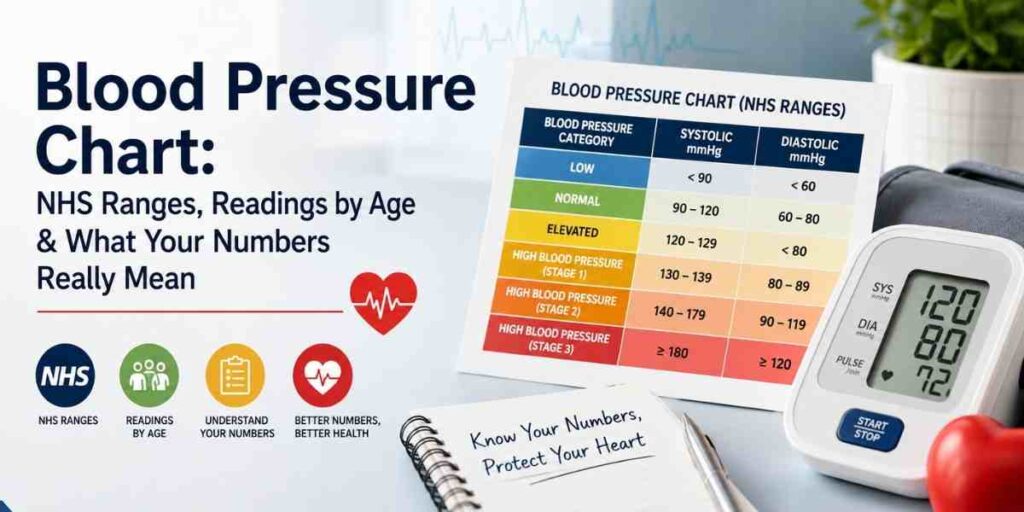
This chart uses the categories defined by the NHS and NICE guideline NG136. Find your systolic (top number) and diastolic (bottom number) to see where you fall.
Source: NHS, NICE guideline NG136, British Heart Foundation. Alt text suggestion: Blood pressure chart showing NHS categories from low to hypertensive crisis with colour-coded ranges.
📈 Check Your Reading Right Now
Enter your blood pressure numbers into our free calculator to see exactly where you fall on the chart.
2. How to Read Your Blood Pressure Numbers (What Most People Get Wrong)
A blood pressure reading is always written as two numbers separated by a forward slash — for example, 120/80 mmHg. Many people assume both numbers need to be high for there to be a problem. That’s wrong — and it’s a mistake that can cost lives.
- Systolic (top number): The pressure in your arteries when your heart beats and pushes blood out. This is the higher number.
- Diastolic (bottom number): The pressure in your arteries when your heart rests between beats. This is the lower number.
- mmHg: Stands for “millimetres of mercury” — the standard unit for measuring blood pressure worldwide.
If either number is elevated — not both — your blood pressure is still considered high. A reading of 150/78 means your systolic is high even though your diastolic is normal. A reading of 118/95 means your diastolic is high even though your systolic looks fine. Either one on its own is enough to flag a problem.
3. Blood Pressure Chart by Age: What’s Typical at Every Stage of Life?
Blood pressure naturally changes as you age. Younger adults tend to have lower readings, while blood pressure gradually rises as arteries stiffen over time. The table below shows typical average ranges for UK adults at different ages.
Source: NHS, NICE, and British Heart Foundation population data. These are averages — individual targets may differ. Always consult your GP.
The NHS uses the same diagnostic threshold — 140/90 mmHg in clinic, 135/85 mmHg at home — regardless of age. “Average for your age” does not mean “safe for your age.” A 70-year-old with a reading of 138/88 may be told it’s “normal for their age” by well-meaning relatives, but clinically, they are on the border of Stage 1 Hypertension and should be monitored.
Related: Normal Blood Pressure by Age — Complete Chart for Men & Women
Detailed interactive breakdown by decade, with separate ranges for men and women.
4. Blood Pressure Ranges for Men vs Women: Does Gender Matter?
In general, men tend to have slightly higher blood pressure than women throughout most of adulthood. However, this gap narrows — and often reverses — after menopause, when declining oestrogen levels reduce the protective effect on blood vessels.
Notice how women’s readings catch up and overtake men’s numbers from around age 55–65. This is the menopause effect — and it’s one reason why heart disease risk in women climbs sharply after 55.
Despite the average differences, the NHS does not use different treatment thresholds for men and women. The diagnostic cutoff is 140/90 mmHg for everyone. If your reading is above this level, your GP should investigate regardless of your gender.
5. What Each Blood Pressure Category Actually Means for You
💚 Low Blood Pressure (Below 90/60 mmHg)
Many people live with naturally low blood pressure without any issues — it’s often a sign of good cardiovascular fitness. It only becomes a problem if it causes symptoms like dizziness, fainting, blurred vision, or fatigue. If your reading is consistently below 90/60 and you feel fine, you generally don’t need treatment.
✅ Ideal / Normal (90–120 / 60–80 mmHg)
This is where you want to be. Your heart is working efficiently without placing excessive strain on your arteries. Maintain this by staying active, eating well, limiting salt and alcohol, and managing stress. Continue to check your numbers periodically — once a year is a good baseline for adults with normal readings.
🟡 High-Normal / Pre-High (120–139 / 80–89 mmHg)
You don’t have hypertension yet, but you’re heading in that direction. This is the intervention window — the stage where lifestyle changes are most effective at preventing progression. Focus on reducing salt, increasing exercise, maintaining a healthy weight, and limiting alcohol. Your GP may recommend more frequent monitoring.
🟠 Stage 1 Hypertension (140–159 / 90–99 mmHg)
A single clinic reading in this range doesn’t automatically mean you have hypertension. Under NICE guidelines, your GP should confirm with ambulatory blood pressure monitoring (ABPM) or a course of home readings over 4–7 days before diagnosing. If confirmed, your doctor will assess your overall cardiovascular risk and may recommend lifestyle changes, medication, or both.
🔴 Stage 2 Hypertension (160–179 / 100–109 mmHg)
At this level, medication is usually recommended alongside lifestyle changes. Your GP will typically start treatment more promptly and may refer you for additional tests to check for organ damage (blood tests for kidney function, ECG for heart rhythm, urine tests for protein).
🚨 Hypertensive Crisis (180+ / 110+ mmHg)
If your reading is 180/110 mmHg or above, sit quietly and re-check after 5 minutes. If it remains this high and you have any of these symptoms — severe headache, chest pain, vision changes, confusion, shortness of breath, or nosebleed — call 999 immediately. This is a hypertensive crisis and can cause stroke, heart attack, or organ damage within minutes. If you have a high reading but no symptoms, contact your GP or call NHS 111 for urgent same-day advice.
6. The Danger Zone: 5 Blood Pressure Readings That Demand Immediate Action
Not every high reading is a crisis. But certain patterns and numbers should prompt you to act without delay:
- 180/110 mmHg or above with symptoms — Call 999. This is a hypertensive emergency.
- 180/110 mmHg or above without symptoms — Contact NHS 111 or your GP for urgent same-day assessment.
- Consistently above 140/90 mmHg — Book a GP appointment. You may need home monitoring to confirm hypertension.
- A sudden drop below 90/60 mmHg with dizziness or fainting — Sit or lie down immediately. If it persists, seek medical help.
- A difference of more than 15 mmHg between arms — Tell your GP. This can indicate arterial narrowing and may need further investigation.
7. Home vs Clinic Readings: Why the Numbers Are Different (And Which One Matters More)
If you’ve ever noticed that your blood pressure reads higher at the GP surgery than at home, you’re not imagining it. This is well documented and the NHS accounts for it.
This difference exists because of the “white coat effect” — the natural anxiety many people feel in a clinical environment. NICE guidelines now recommend that home or ambulatory readings are used to confirm any hypertension diagnosis, because they are generally more accurate and reflective of your true blood pressure.
Related: How to Work Out Your Average Blood Pressure
Why averaging multiple readings gives a far more reliable picture than a single number.
8. How to Measure Your Blood Pressure Correctly (6 Steps Most People Skip)
An inaccurate reading is worse than no reading at all — it can cause unnecessary panic or false reassurance. Follow these steps every time:
- Rest for 5 minutes first. Sit quietly with your back supported, feet flat on the floor, legs uncrossed.
- Avoid caffeine, exercise, and smoking for at least 30 minutes beforehand.
- Use the correct cuff size. Too small inflates the reading; too large deflates it. Most adults need a standard cuff; larger arms need a large cuff.
- Place the cuff on bare skin on your upper arm, level with your heart. Not over clothing.
- Take two readings, 1–2 minutes apart. Record both. Your GP will typically use the second (lower) reading.
- Don’t talk during the reading. Talking can raise systolic pressure by 10–15 mmHg.
Use a BIHS-validated (British and Irish Hypertension Society approved) upper-arm monitor — not a wrist monitor. Wrist monitors can be significantly less accurate if not positioned perfectly. You can check the BIHS approved list to find validated models.
9. How to Move Down the Chart: Proven Ways to Lower Blood Pressure
If your reading falls in the High-Normal, Stage 1, or Stage 2 categories, these evidence-based strategies can help bring your numbers down — in some cases, enough to avoid or reduce medication.
Related: 8 Diet Changes That Actually Lower Blood Pressure
Evidence-based dietary shifts with exact data on how much each one moves the needle.
🏥 Where Do You Fall on the Chart?
Enter your readings into our free calculator to see your average and what it means.
10. Frequently Asked Questions
What is considered normal blood pressure in the UK?
Normal blood pressure is a reading between 90/60 mmHg and 120/80 mmHg. This is considered the ideal, healthy range for most adults. The NHS uses 140/90 mmHg as the clinical diagnostic threshold for high blood pressure.
What do the numbers on a blood pressure reading mean?
The top number (systolic) measures the pressure when your heart beats and pushes blood out. The bottom number (diastolic) measures the pressure when your heart rests between beats. Both are measured in millimetres of mercury (mmHg). If either number is too high, your blood pressure is considered elevated.
Does blood pressure change with age?
Yes. Blood pressure tends to increase gradually with age as arteries become stiffer. However, the NHS diagnostic threshold for hypertension (140/90 mmHg) remains the same regardless of age. A reading that is “normal for your age” may still be clinically elevated.
Is 130/85 high blood pressure?
A reading of 130/85 mmHg falls into the High-Normal category. It is not classified as hypertension, but it is above the ideal range. At this level, the NHS typically recommends lifestyle changes such as reducing salt, exercising more, and maintaining a healthy weight.
What blood pressure reading is a medical emergency?
A reading of 180/110 mmHg or above combined with symptoms such as severe headache, chest pain, vision changes, or confusion is a hypertensive emergency. Call 999 immediately. If you get this reading but have no symptoms, contact NHS 111 or your GP for urgent same-day advice.
Why is my blood pressure different at the doctor’s office?
This is called “white coat hypertension” — the anxiety of being in a clinical setting triggers a temporary blood pressure spike. It affects 15–30% of people. This is why NICE guidelines recommend confirming any high clinic reading with home or ambulatory blood pressure monitoring before diagnosing hypertension.
How often should I check my blood pressure?
If your blood pressure is normal, check it at least once every 5 years (or at your NHS Health Check if aged 40–74). If it is in the High-Normal range, check annually. If you are on blood pressure medication, your GP will advise on frequency — typically at least every 6–12 months, with home monitoring in between.
Is low blood pressure dangerous?
Low blood pressure (below 90/60 mmHg) is only a concern if it causes symptoms such as dizziness, fainting, or fatigue. Many healthy people — especially young adults and athletes — have naturally low readings with no problems. If you regularly feel dizzy or faint, speak to your GP.